Reflection Experience
Reflection with glass bottle:


For the reflection on glass set, all the photos were taken in the studio. I used vase with irregular shape to make Annie’s face distorted. By letting Annie perform different postures and making the vase at different positions. I also changed the photos to black and white, and also made the ISO higher.
Reflection with mirror:


In this set of photos, I used mirror reflection of natural scenes, such as leaves and water. The photos range from close up and distant view. The first photo, I placed the mirror on the ground and captured the reflection of the leaves on a tree. All the other photos includes the components of water in some kind. By changing the aperture, I was able to photograph different color tones.
Reflection Experience: glass reflection
Research the Starting Point
Lee Friedlander:


Naoya Hatakeyama:


Lisette Model:


Robert Holden:


Lee Friedlander was born in Aberdeen, Washington, and became interested in photography at the age of 14. From 1953 to 1955, he studied photography at the Los Angeles Art Center School and then began his freelance career. Lee Friedlander photographed the reflection of a mirror, especially the reflection on a wing mirror of a car. He creates street photography that often contains his shadow or reflection, adding a strange and uncomfortable edge to his observations. His photographs follow the traditional photography by Walker Evans and Robert Frank, which is always aware of the relationship between the photographer and the image and considers it at least as important as the surface theme of the image – usually an empty street, shop window, or an inconspicuous town statue. Naoya Hatakeyama was born in Iwate Prefecture, Japan in 1958. Hatakeyama is a student of Kiyoji Otsuji and completed her graduate studies at the University of Tsukuba in 1984. Since then, Hatakeyama has been based in Tokyo, which has been a model for his development of a series of works that primarily focus on the relationship between nature, cities, and photography. He likes to use water to create photographs, in his works, there could be photographs of the reflection of a building on a river or photographing through a mirror with water droplets. He explored the significance of landscapes where all land is affected by human activities today. He insists that even the scenery we admire is famous for its pristine beauty. Lisette Model (1901 – 1983) was born in Vienna, she studied piano and composition theory before moving to Paris. In 1933, she ended her music career and discovered photography through her sister. Soon she decided to become a full-time photographer and completed a brief apprenticeship with Florence Henri in 1937. The following year, she immigrated to New York City with her husband, the painter Evsa Model. Her photos are very successful which captures human figures through the reflection of windows, and his photos are usually black and white. Her works are renowned for emphasizing the uniqueness of ordinary people in their daily lives, as well as direct and honest depictions of modern life and its impact on human character. Robert Holden did a little differently than other artists who used reflection. Even though they all creates daily-life photographs, Holden is determined to create photographs that show self-reflection. The three previous photographers all uses an object that can actually reflect something else, but his uniqueness of using reflection makes him stand out. His works revolve around the humanistic concept of travel journey and encounter are his themes. His photography technique is subjective and emotional. Many of his projects are based on reality, and they are all everyday objects.
Citation:
- “Lee Friedlander.” International Center of Photography, 15 Dec. 2023, www.icp.org/browse/archive/constituents/lee-friedlander?all%2Fall%2Fall%2Fall%2F0.
- “Lisette Model.” International Center of Photography, 15 Dec. 2023, www.icp.org/browse/archive/constituents/lisette-model?all%2Fall%2Fall%2Fall%2F0.
- “Naoya Hatakeyama.” Taka Ishii Gallery / タカ・イシイギャラリー, www.takaishiigallery.com/en/archives/5925/. Accessed 8 Sept. 2024.
- “Robert Holden (Photographer).” Wikipedia, Wikimedia Foundation, 11 Aug. 2023, en.wikipedia.org/wiki/Robert_Holden_(photographer).
Artist Statement

Emma Zhang (2009, Beijing, China)
I’m fascinated by the interplay of chance, interpretation, and situation that shape our lived experiences. Through my lens, I aim to capture the unexpected and fleeting moments that reveal the underlying complexities of the world around us.
My practice is grounded in the subjective nature of perception that challenge the viewer’s expectations and invite deeper contemplation. I imbue my photographs with a dreamlike quality, metaphorizing the fluid nature of our experiences.
I believe our understanding is shaped by our unique backgrounds and biases. I invite the audience to engage in active meaning-making, drawing their own conclusions. Equally important is the role of chance, as I work intuitively to capture moments of serendipity and unexpected beauty.
Developing Ideas
Materials:
- mirror
- water
- glass
Techniques:
- leading line
- framing
- depth of field
- out of focus
Equipments:
- people
- objects
Techniques of Photography
Rule of Third: The first photo shows a significant contrast of the red, emphasizing the dog. The dog filled 1/3 part of the whole photograph which makes it an example of rule of third. I cropped the second photo to make the dog to be on the right side of the photo and filling 1/3 of the space. It depicts a feeling of hiding since there’s leaf covering some part of the dog.


Leading Lines: The first photo is a close up of the dog, which stands on a bright color line that makes the audience focus more on the main object. The second photo is taken at the same place but is a sky view and a more macroscopic view. The color contrast makes the dog stand out to audience but also reflects a feeble feeling because the dog seems relatively small than the background.


Symmetry and Patterns: The first photo is an example of symmetry, the dog is in the middle of the photograph with two symmetrical holes beside it. The second photo uses the technique of patterns which the background has identical little holes, but the dog grabs the audiences’ attention since it contrast with its background. The dog’s posture in this photo looks timid.


Framing: In the first photo, there’s lots of objects around the dog, but they’re all out of focus, which draw attention to the dog. In the second photo, there’s a big contrast between the bright blue and the dog is shadowed. Although the color of the dog isn’t the most obvious, the bright blue is out of focus which puts the focus on my main object. I used the blue cone to makes the photo reveal a sense of scared and trapped.


Depth of Field: In the first photo, the dog is placed on the branches of a plant. The branches are out of focus and the dog is on focus. In the second photo, even though the leaf is in front of the dog, and usually people sees the object that’s in the front. I put the focus on the dog, which emphasizes the dog.


Negative Space: There’s a lot of empty space in the fist photo, and the background is mostly one color, which makes the dog stand out. And the color tone is really bright, which gives the audience a feeling freedom and a room to breathe. The second photo is a close up photo compared to the first one, the dog is the only object in the photo and the background is plain and simple. Even though it is not as macroscopic view as the first photo, it still has a plenty of space around the main object. And the dog is laying on the ground, it also gives a sense of freedom.


Balance: The first photo has a balance composition since the main object is in the middle and the background is spread evenly in the photograph. And the dog fits in the hole very well so every thing in this photo looks just right. In my opinion, taking a balanced photograph is making it symmetry, so in the second photo, I placed the dog in the middle of two shelves. This way, with the main object in the middle and the background symmetry, the photograph is visually balanced.


Perspective: In the first photo, the table leg (black part) is covering half of the dog, the angle of this photo makes the dog looks like it’s observing something carefully. The dog in the second picture is hidden under a leaf. By photographing it high above so that the leaf covers the forehead of the dog, it can make the audience feel like the dog is hiding from rain.


Evaluation
The edges of the drawer help the audience to focus more on the things inside. The unified color tone helps the audience have a more visual feeling of the main objects. The audience’s focus can be on any of the objects because all the small pieces represent a part of my life, and every detail could reflect my vision. No matter where the audience looks, they see things that are ordinary, so this can remind them of their own life. The image contains lots of objects, so the main focus can be on various things. When the audience focuses on any of the objects, it could be the main message. It’s not really any distractions in my images. My vision is to discover the ordinary things in life and cherish the situation you’re in right now. My photograph portrays my drawer, which is a thing that I look into every day. It reminds me of all the things I have and it tells me that I have a lot of things that others don’t, so be satisfied with the reality. From the feedback from others, they feel warm when looking at my picture. My picture is supposed to make the audience feel an emotion of relaxation, and think of their home and life.
Statement of intent
The title of this project is The Connection Between Life and Us. The societal/cultural issue I want to explore with my photographs is the uniqueness of different people’s lives and everyone should cherish their current lives. I want my audience to feel connected with their lives and let them notice how life can be valuable. I will get inspiration and develop my ideas by looking for photographs that show lifestyle and ordinary scenes in people’s lives.
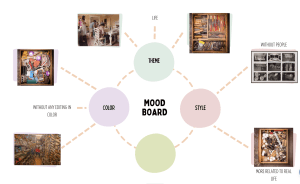
Mood Board