1st photographer: Lee Friedlander
Lee Friedlander is an American photographer and artist who influenced by Eugène Atget, Robert Frank and Walker Evans in his early age of creating arts and photographs. “America by Car” is one of his series of reflection from September 4th to November 28, 2010 that showcases the collection of photographs of Friedlander’s journey of visiting country’s fifty states in an ordinary rental car that inspired me with several different reasons. The series captures a variety of landscapes, urban areas, and scenes from everyday life which viewed through the windows of his car. Also, the series is about the exploration of American culture and identity through the lens of the automobile, which has been a significant symbol in the U.S. And this reflects on themes of mobility, freedom, and the complexity of modern life as the images often feature reflections in the car windows, which could be interpreted as metaphor for how we perceive the world around us.
America by car:

Inspired photo from the series:
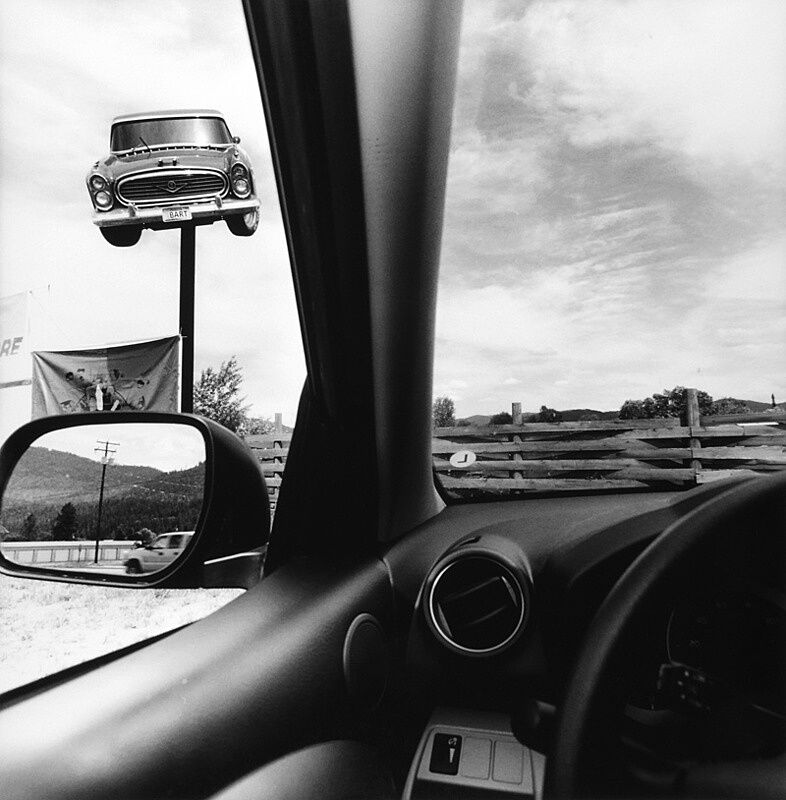
This photograph, part of Lee Friedlander’s collection displayed from 1995 to 2009 at the Fraenkel Gallery in San Francisco, inspires me due to its use of composition, white balance, and line. Friedlander’s composition employs leading lines, perspective, and contrast to enhance the effect of reflections and emphasize the symbol of the car with a fast shutter speed(1/500?). The point of view from inside the vehicle grabs the audience’s attention to the elements of the car itself, and the lines created by the door frame and the top of the handle guide the eye heads the corners of the image, using leading lines to focus attention on the automobile. Additionally, the contrast between the upper right and lower left corners of the photograph not only highlights the interaction of light but also reinforces the significance of the car as a symbol, for the upper section reveals the entire part of car, while the lower section presents only fragments of its interior. And this juxtaposition underscores the duality of the experience Mthe exterior world seen through the vehicle and the intimate space within it. Moreover, the light balance he employs in the photograph captures details in both highlights and shadows while adding depth and texture which make the subject more interesting. Furthermore, by capturing the thick curved lines of the automobile, Friedlander aimed to evoke softness while emphasizing the distinction between the interior and exterior of the car.
2nd photographer: Antonio Gutierrez Pereira
Antonio Gutierrez Pereira is a photographer who came from Portugal and born in 1948, inspired to use glass of water and facial expression to create reflection photographs. It’s quite hard to determine the exact name of her photo series and the dates that created, but there are various amount of photograph of her which inspired me to use facial expressions and motions. Using water as a main concept of reflection photos are quite common; however, Pereira uses both of the traits of water and glasses to create trick of distorted reflection and impressiveness, which is flextion. By using the flextion of water in glasses, she collaborate that with the some parts from our face to give different perspective from other reflection photo, and this facsinated and inspired me to use the flexation of glasses with various materials in my practice photos.

Inspired photo from her:

While I was researching, I couldn’t find the exact name of this photograph but it stands out as one of her most inspiring works due to its composition, focus, and the use of slow shutter speed (1/125) that created distorted reflections. By utilizing a glass of water to distort the model’s face, the arrangement of the face and glass results in a harmonious collaboration that splits the face in half, tricking the audience’s eye with the effect of refraction. This distortion makes the reflection special, symbolizing the contrast between our exterior and interior selves; the reflected face representing the inner self, while the unreflected side represents the outer part.
Furthermore, Pereira utilized a board in the middle of the photograph, introducing a second reflection. This not only emphasizes the smooth curves of the glass and the model’s facial lines but also highlights the sharp lines created by the light reflecting off the bottom of the glass. Her use of distorted reflection not only adds uniqueness to the photograph but also symbolizes the distinction between inner and outer beauty in our minds.