
Daisy
"I have no special talent. I am only passionately curious" - Albert Einstein
Category: Uncategorized (page 1 of 2)
A portrait is a photograph that focuses on capturing the appearance, personality, and mood of a person or group of people. It usually highlights the subject’s face and expression, but it can also include the body, posture, and environment to communicate more about who they are. Portrait photography often uses specific techniques such as controlled lighting, shallow depth of field, and framing to draw attention to the subject and separate them from the background.
A successful portrait doesn’t just show what a person looks like. It reveals something deeper about their character, emotion, or story. Photographers might use eye contact, gesture, or composition to express intimacy, confidence, or vulnerability. Portraits can be posed, where the subject knows they are being photographed, or candid, where the person is captured naturally. Overall, portrait photography is about using technical and artistic choices to communicate human identity and emotion through an image.
Artist: Richard Avedon
Richard Avedon’s portraits are known for their simplicity and focus. He often used plain white backgrounds and strong contrast to highlight expression and emotion. In his series In the American West, he photographed ordinary people with deep honesty and intensity. His work proves that strong portraits don’t need complex settings, just connection between photographer and subject.

This photo is a compelling example of street photography, weaving together composition, light, the decisive moment, and contextual storytelling into a cohesive and richly detailed narrative. Employing the rule of thirds and multi-layered framing, it balances the moving cyclist in the lower right with the mid ground’s tranquil water and ornate railing, and the background’s tree-lined skyline, creating a visually engaging structure. The high-contrast black-and-white palette elevates the interplay of light and shadow: the lamp post’s long, graphic shadow interacts dynamically with the cyclist and road, while the cyclist’s light clothing stands out against the darker pavement, making the candid, unposed moment of motion—the core of the “decisive moment”—pop with energy. Moreover, the scene merges man-made elements (the modern road, traditional lamp, and historical railing) with natural ones (the water and trees), highlighting the dialogue between urban life and nature, and imbuing the image with cultural and temporal depth. This blend of technical precision, emotional authenticity, and atmospheric storytelling—enhanced by the timeless, cinematic quality of black and white—captures the quiet yet resonant essence of street photography: a fleeting, authentic moment that reveals the layers of life, light, and place in a single frame.


My practice centers on documenting the quiet, unscripted moments of everyday life. The subtle interactions, routine gestures, and overlooked details that reveal the authenticity of human experience. Inspired by Gianni Berengo Gardin’s commitment to “honest photography,” I aim to avoid staging or romanticizing subjects; instead, I seek to capture “life as it is”. As it being imperfect, and emotionally resonant. My goal is to create images that invite viewers to pause, notice the beauty in ordinariness, and reflect on the shared humanity that connects all people, regardless of context.
Gianni Berengo Gardin is an Italian street photographer known for his black-and-white photos that capture real people and honest moments. His work focuses on human life, emotion, and connection, which connects to my concept of showing life inside the Hutongs.
One thing I notice about Gardin’s work is his use of natural light and shadow. He doesn’t need bright colors to tell a story—his images use contrast and composition to make ordinary scenes feel meaningful. In his photos, people are often unaware of the camera, which makes the moment look natural and true.
I also like how Gardin pays attention to culture and community, showing how people live and work together. His photography reminds me that beauty is not about perfection but about real life. I want to use his style as inspiration in my own project—to focus on people’s daily lives, capture emotion through small details, and show the beauty of ordinary moments in the Hutongs.
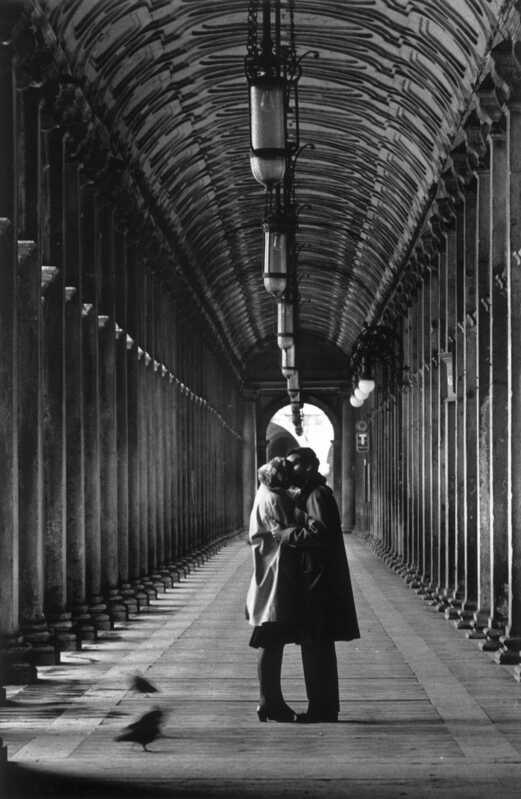
This photograph shows two people sharing an intimate moment in the center of a long, arched walkway, and when I look at it, I feel a calm and emotional atmosphere. The black-and-white tones give the scene a timeless quality, and the repeating columns and ceiling lines guide my eyes straight toward the couple, making them the clear focus. I notice how the symmetry of the space and the contrast between their darker clothing and the lighter background highlight their connection, making the moment feel private even though it’s happening in a public place. To me, the image suggests themes of love, human connection, and how relationships can influence someone’s identity. When I think about creating a photo like this myself, I would look for a long hallway, tunnel, or walkway with strong leading lines and stand directly in the center to capture the symmetry. I’d place my subject in the middle so they stand out, and I might shoot in black and white or convert the image later to get that classic, emotional mood. I’d also aim for soft lighting to add depth, and I would ask my models to interact naturally so the photo feels genuine and intimate, just like this one.
Humanistic Charm
Residential Life Scenes: In the hutongs, you can capture the daily lives of residents, such as elderly people chatting and playing chess at their doorsteps, or sunbathing and preparing vegetables in their courtyards, showcasing the vibrant atmosphere of old Beijing. For example, in Dongsi Hutong, you can often see residents relaxing under old locust trees.
Traditional Craftsmen: Some hutongs may have traditional craftsmen making dough figurines, sugar figurines, or paper cuttings. Capturing their focused creations and their exquisite handicrafts can document the traditional skills of old Beijing.
Unique Shops: Hutongs like Wudaoying have many artsy cafes, bars, and handicraft workshops, while Yangmeizhu Xiejie has retro bookstores and coffee-book bars. You can photograph the shop signs, windows, interior layouts, or people relaxing in the shops, reflecting the artistic atmosphere of the hutongs.
Historical Buildings:
Western-style architecture in Dongjiaomin Lane: Dongjiaomin Lane was once the embassy district and retains a large number of Western-style buildings of various styles, such as remnants of bunkers, fragments of boundary walls, and hitching posts in the British barracks stables. These architectural remains are full of historical vicissitudes and are excellent subjects for photography.
The brick pagoda in Zhuan Ta Hutong: Zhuan Ta Hutong is named after the brick pagoda at its eastern entrance. This brick pagoda is a landmark of one of the oldest hutongs in Beijing. Combined with the surrounding old Beijing buildings, it offers opportunities for charming and evocative photos.
Hutong Street Scenes:
Dappled Light and Shadow in the Alleys: In the early morning or evening, sunlight filters through the branches, casting dappled light and shadow on the ground and walls of the hutongs. Photographing the hutongs at this time creates a tranquil and warm atmosphere. Hutongs like Caochang Hutong and Lanman Hutong are excellent choices.
Gray Bricks and Tiles with Greenery: The gray bricks and tiles of Beijing’s hutongs are a distinctive feature. Combined with ivy climbing the walls and loofah vines under the eaves, they are full of life and natural beauty. For example, in spring, the rooftops of every house on Yangmeizhu Xiejie are covered in greenery, making it very photogenic.

© 2025 Daisy
Theme by Anders Noren — Up ↑
Recent Comments