


Henry
"I have no special talent. I am only passionately curious" - Albert Einstein

Rule of thirds framing, contrasting red and black, subject blends in with background

Lines of the stairwell lead the viewers eyes to the subject, dark lighting and reflection of the subject is shown

Subject is framed by the wooden supports, dark lighting emphasizes the light through the window and the highlights on the wood

High perspective of the subject in a flower pot, highlight on the subject’s head is clear, leaf in the foreground creates depth

Unique low perspective, poorly focused but possible adds an effect

Contrasting red & black colors again, the lines of the sofa are used for the composition

Light used to cast a mirroring shadow, depth of field/negative space of the wall

Natural scenery, slight depth of field with the leaf, subject is almost lifelike

Red brick pattern and lots of empty space, you almost cannot see the subject

Circular ripple pattern of a carpet, looks like the subject is almost causing it


To develop my concept of contrasting light, I will draw inspiration from the techniques of Rembrandt and Chiaroscuro photography. Rembrandt lighting has a very specific look, while Chiaroscuro literally means “light and dark,” referring to the technique where a subject is made three-dimensional through lighting.
Example Photos:


I also want to incorporate reflections in some way, perhaps through mirrors, water, or other means. I have worked with reflection in the abstraction unit so I wish to continue exploring its use in a more personal, realistic setting.
If possible, I wish to also use light and dark to convey a message about how we get past difficult times in life, contrasting the stress and darkness of life with a relieving moment of brightness, or contrasting life’s struggles with its happiness, making viewers consider how they view life.
For this project, I aim to explore the interplay between contrasting lights and how different colors, intensities, and qualities of light interact with shadows and illumination to reveal dimension, mood, and drama in portraiture. I’m interested in examining how light and dark contrasts, as well as color temperature variations (warm versus cool light), can transform our perception of identity and emotion in portrait photography.

This is a photo by Angela Markew that captures what I wish to achieve in my photos. The subject is the main focus as the background is blank, and the subject’s face has a combination of warm and cool lighting that brings out their facial features.
The artist I will study is Ian McCausland. Ian MCausland is a Canadian commercial and editorial photographer based in Winnipeg, Manitoba, who has spent over 30 years mastering the art of storytelling through portraits and documentary work. I am drawn to his approach because he centers on creating images that reveal the authentic character of his subjects, often through bold experimentation with lighting and color that directly aligns with my own exploration of contrasting light and shadow.
What particularly interests me about McCausland’s work is his sophisticated understanding of chiaroscuro principles in portrait photography. He employs dramatic lighting setups to create depth and dimensionality in his subjects, a technique I want to develop in my own practice. Like Rembrandt’s masterful use of light and shadow, McCausland sculpts his subjects through carefully controlled illumination, allowing darkness to define form as much as the light itself. His philosophy of “flip it and trip it”radically changes his approach mid-shoot by swapping gels, altering poses, or reversing light placement, inspiring me to adopt a similarly experimental mindset that transforms technical mastery into emotional storytelling.
I find McCausland’s work particularly relevant to my intent because of his exploration of color contrasts and reflective surfaces. In his “Colour Light” series, he demonstrates how complementary colors, such as red and blue, can create visual tension while the interplay of light on different surfaces adds layers of meaning to the portrait. This experimental approach to colored gels and their reflections offers me a contemporary interpretation of traditional chiaroscuro that I can incorporate into my own work, especially as I continue exploring reflections in more personal, realistic settings.
McCausland’s emphasis on authenticity and revealing the “soul of the moment” resonates deeply with my desire to use light and dark as metaphors for life’s struggles and moments of brightness. His ability to strip away superficial elements and focus on essential character through lighting choices parallels my conceptual goal of contrasting life’s darkness with its relieving moments of light. The three-dimensionality he achieves, making subjects emerge from shadow into illumination, serves as a powerful visual metaphor for overcoming difficult times, which is precisely the message I hope to convey in my work.
By studying McCausland’s techniques, I aim to combine technical precision with emotional depth, drawing on his willingness to experiment with unconventional setups to develop my own photographic voice while exploring themes of struggle, relief, and the human capacity to find light in darkness.
Portraiture is the art of creating images that represent a specific person or group, capturing not only their physical appearance but also their personality. Portraiture is intentionally focused on the subject, seeking to show something truthful about their identity through careful consideration of lighting, composition, expression, and environment. Portraiture serves as both documentation and interpretation, preserving a moment in time, along with the emotion exhibited by the subject.
At its core, a portrait serves as a bridge between the photographer’s vision and the viewer’s understanding of the subject. It can be literal, showing someone’s physical appearance, or conceptual, expressing their inner world, emotions, or the photographer’s perspective on identity and humanity.
In my photography project, I aim to draw more attention to underappreciated individuals in today’s society, such as janitors, school staff, and security guards. I will capture these workers in the monotony of life, out of the eyes of less perceptive individuals, still living unique and rich lives of their own. I will primarily focus on the area around ISB, as the school is barely operational without its staff, so they will be a key highlight in my project. I hope that through my photos, viewers (hopefully ISB students) can appreciate China’s underappreciated staff and become more aware of the effort they put into maintaining our comfortable student lives.
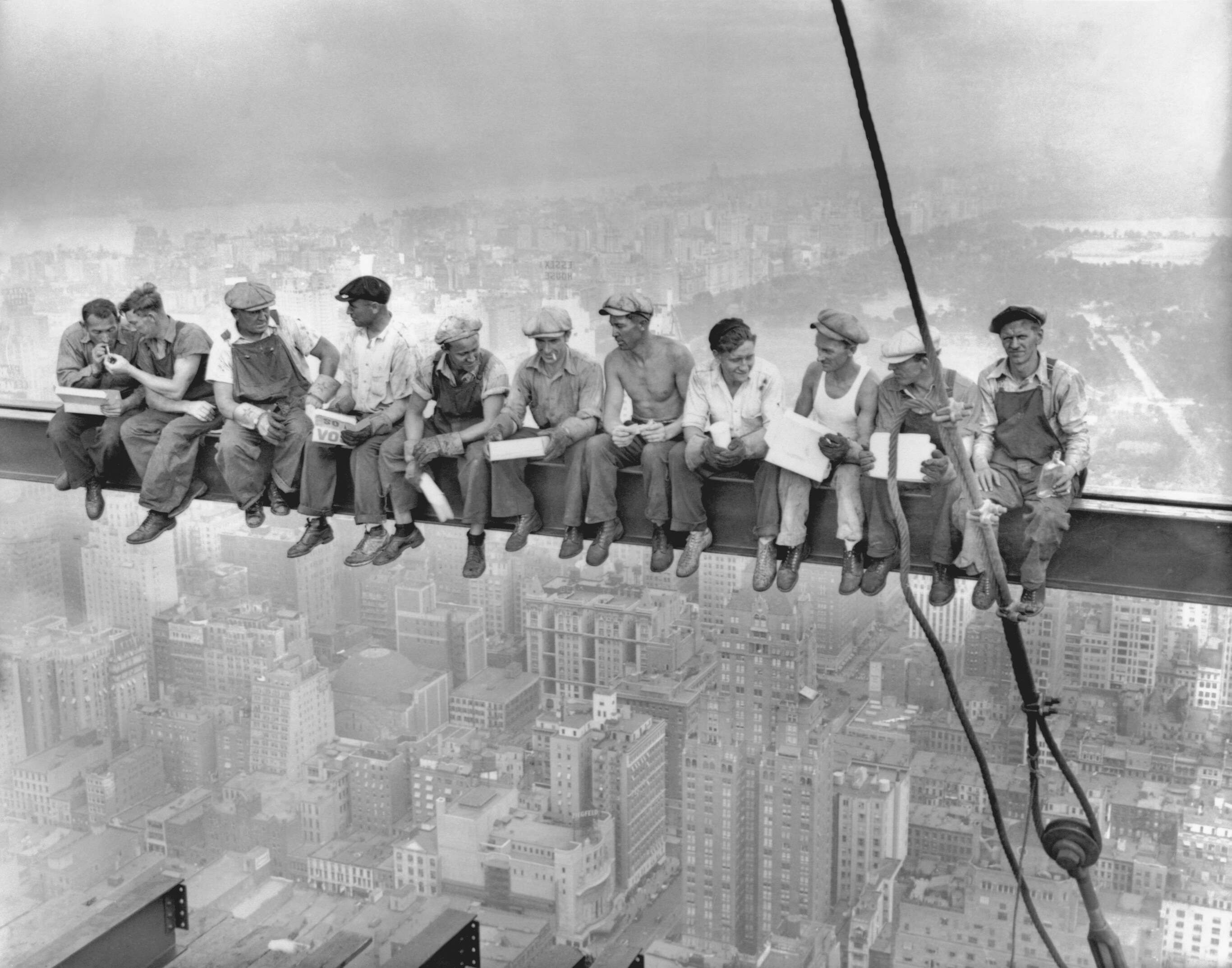
My work is inspired by Lewis Hine, a photographer of the 1800s, whose work highlighted the cruel treatment of industrial workers in factories, construction, railways, and other industries. His work was crucial in exposing the U.S’s use of child labor, and his work was believed to have contributed in the creation of America’s earliest child labor laws. One of his most famous works is “Lunchtime Atop a Skyscraper,” showing construction workers having lunch break on a dangling metal beam in the construction of the RCA building in Manhattan, showing the bravery and risk-taking that construction workers had for the growth of society.
Reference Photo:
Reflecting on the street photography unit, I believe I could have taken more action to get my required shots, as I missed the Hutong trip to make up an exam. Although I had a good idea for my shots, I don’t think my shots were of the highest quality, as I did not have a higher quality camera to use since it got very lost in the middle of moving houses. I resorted to my iPhone, and many of the shots in my set were taken at night, where a professional camera would have had much more success in capturing more light. I wish that I took the time to go on the Hutong trip where I could have had a better environment for my shots. I needed better lighting and more subjects to work with, as my intent was to capture underappreciated workers, but it is often hard to get shots of them. For instance, I wanted to take a picture of the guard in front of Yosemite C, but I was not allowed to. Capturing more random photos, although gave me more options to work with, limited the quality of my shots.
The shots I were able to take with the school’s borrowed cameras were much better and allowed me to encapsulate the workers in much higher quality. This unit I experiemented with color, with one shoot in black and white and one in color. I tried to use depth of field and negative space more to further emphasize the viewed insignificance of the workers in my photos. I also experimented with shutter speed and blur in order to show how these workers are often blurred from the world, not the focus of anybody. I intentionally took photographs of workers that fundamentally support our infrastructure nowadays, like takeout drivers and construction workers. In China, there is power in numbers, yet the result of that is individuality is drowned out in the numbers. Without each individual worker, our society would not function as it does today.
Overall, in this unit I think I had a good intention for my shots, but not as good execution. I will take this knowledge into my next photography class and take the opportunities I can to get my pictures, in a suitable environment with professional equipment.


The concept I will focus on the most is Don’t Move. I will try to capture multiple pictures from the same perspective or same location, to emphasize the abundance of workers that pass us by, even just in one location, yet we simply do not notice their presence.
© 2026 Henry
Theme by Anders Noren — Up ↑
Recent Comments