
The French photographer Henri Cartier-Bresson who established himself as the originator of modern street photography received fame for his decisive moment method which involved capturing spontaneous moments when scenes reached their most evocative or visually balanced states. He developed a signature approach based on unscripted documentary photos that showcased poetic precision through his use of a 35mm Leica camera to record real-life moments. Cartier-Bresson attracted viewers through his dynamic approach to street photography by using geometry and rhythm in compositions of urban chaos to construct balanced stories about ordinary scenes. The abstract and dynamic photographs required Cartier-Bresson to use instinctual photography and follow fleeting moments of light and shadow movement while his static photographs revealed architectural forms through careful composition techniques. His fundamental belief centered on photography as the extension of vision and thought because he emphasized both the practice of patience and anonymity as well as genuine emotional authenticity. The themes of universal human experience combined with controlled versus random elements and the beauty in his work shaped the writer’s photography approach through his respect for observation and his belief in subtle compositions and the quest for visual unity in life’s disorder.
Analysis of Henri Cartier-Bresson’s photograph:
Rue Mouffetard, Paris
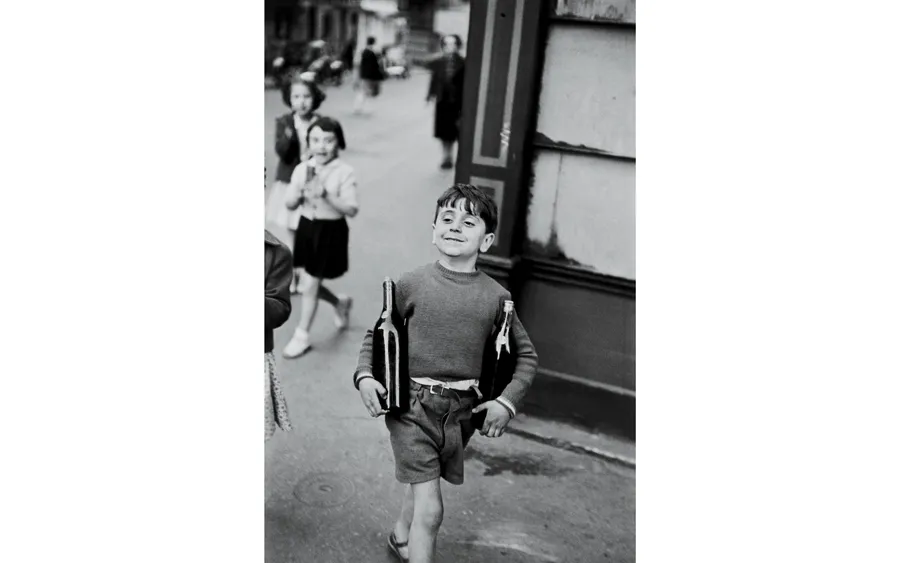
Through his street photograph: “Rue Mouffetard, Paris” (1954) Henri Cartier-Bresson showcases his skill of finding the “decisive moment” which engages the audience by making us relate to the photo. The photograph shows a youthful boy walking down a brick street road while holding two oversized wine bottles in his hands, between prideful confidence and casual joy. Cartier-Bresson’s distinctive style appears in the framing where diagonal movement from the boy opposes vertical lines of buildings and bottle curves replicate arched architecture to create alignment and contrasts throughout the frame.
The image depends on natural human expressions because the boy’s asymmetrical posture with his half-grin and messy clothing represents purity and strength which Cartier-Bresson portrayed as his humanistic characteristic. The recurring depiction of childhood belongs beyond time and place as the young boy displays universal emotion through his timeless expression despite existing within post-war Parisian streets.
Through this composition Cartier-Bresson creates an artistic abstraction from documentary realism to establish street photography as an art form that transforms everyday scenes into artwork. The image stands strong because it contains only one perfectly composed movement demonstrating personal uniqueness along with collective human qualities.
Photo Gallery

Leave a Reply
You must be logged in to post a comment.