Alyssa

"I have no special talent. I am only passionately curious" - Albert Einstein

Analysis of a Photograph- Blog post 5

Aaron Siskind, “Peeling Paint, Jerome, Arizona”, 1949


If I had been the photographer of this photo, I would name it “Eroded Time”, because I associate the idea of “peeling paint” with the passing of time immediately as I think of it.

In this photograph, I think Aaron Siskind was trying to capture the elements of texture, shape, and value/tone. Siskind uses the formal elements of photography to emphasize the feeling of the passing of time and erosion by magnifying the texture of the chipping paint in the photo, making it the main focus. The shape of each peeling paint is unique, and without a specific pattern, this creates a better connection with the real world as a realist abstract photographer. The black and white in this photograph illustrates a strong contrast between chipped and unchipped paint, enhancing visual depth and giving it a better sense of dimension and layer.

Works Cited:

Siskind, Aaron. “Peeling Paint, Jerome, Arizona | the Art Institute of Chicago.” The Art Institute of Chicago, www.artic.edu/artworks/22556/peeling-paint-jerome-arizona.


Formal Elements of Photography-Blog Post 4

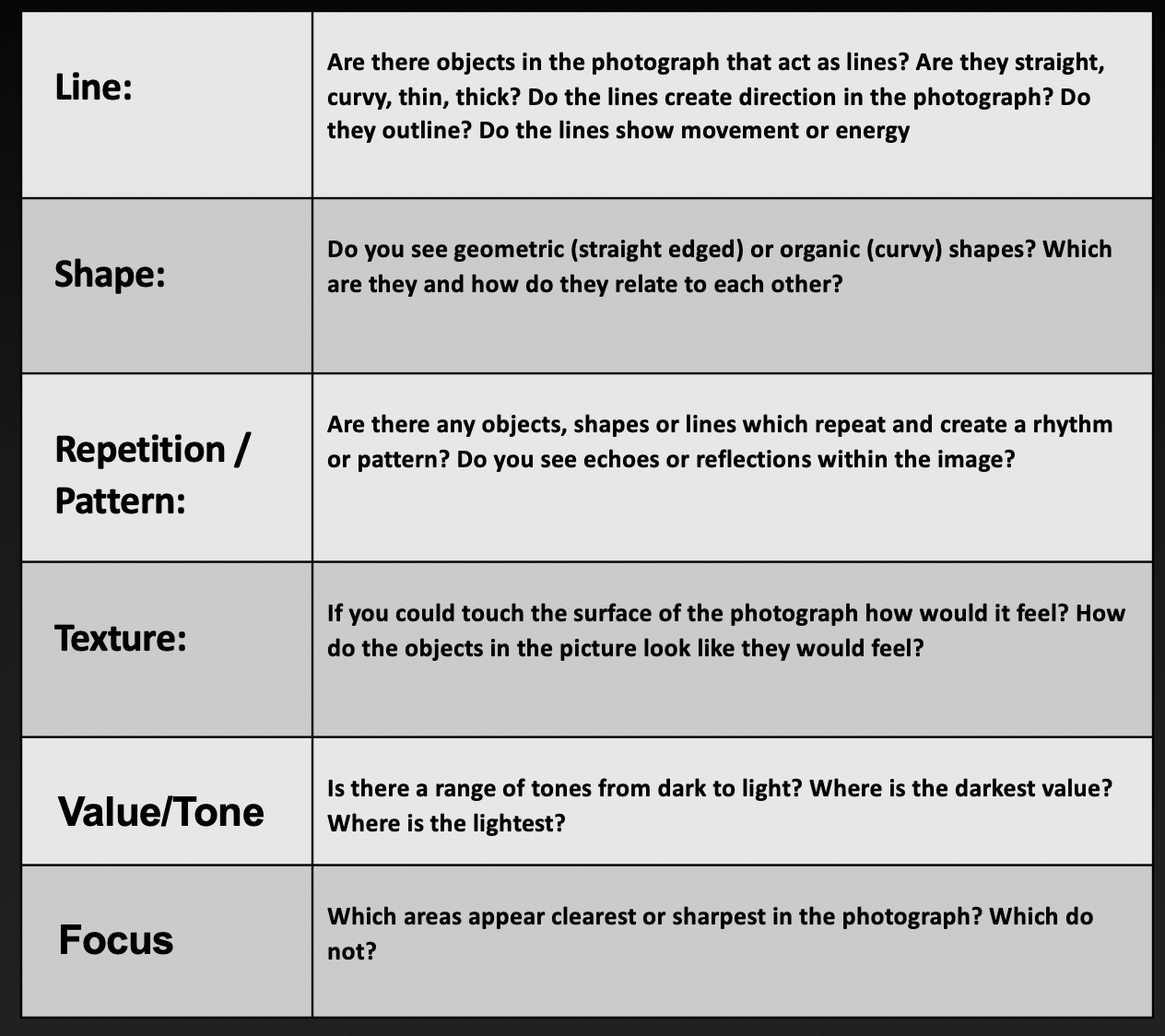
I think it is very hard for an image to have just one element at a time because the elements are all interconnected. A simple line can be viewed both as a “line” and as a “shape”; a group of lines can be observed as a pattern. For example, the photo below features many repeated lines/rectangular shapes. The center also has the lightest value, bringing the focus of the eyes to the center of the photograph.

Andreas Gursky, “Times Square, New York”,  1997


Works cited:

“Andreas Gursky. Times Square, New York. 1997 | MoMA.” The Museum of Modern Art, www.moma.org/collection/works/55649.

Researching the Starting Point

The pictorialism movement in the 1850s emphasized the beauty of photography over accuracy, transforming it from a scientific representation to a form of art. It focused on the aesthetic components and aimed to make everything look and feel dreamlike and romantic. Photographers used techniques such as the “dark room” techniques and added additional brush strokes to further enforce a painting-like effect. Straight photography, on the other hand, was completely different from pictorialism; it valued authenticity and honesty over beauty. The photos clearly captured the sharp edges and intricate details of the image, rather than a smooth, soft atmosphere.


Aaron Siskind, “Jerome, Arizona 21”, 1949

Edward Weston transformed his photography style from soft, painterly to sharp and focused. He moved on from pictorialism to pursue a more abstract side of photography and inspiring the idea of “straight photography.” Similarly, Siskind emphasized the different elements in photographs, such as the texture and lines of objects instead of soft images that are seen in pictorialist photographs.

Field #9, 1995, Uta Barth. Chromogenic print. © Uta Barth

The contemporary artists Uta Barth and Andreas Gursky create abstraction in a special way as modern photographers. Barth coveys themes spiraling around the ideas of “perception, optical illusion, and non-place” (Wikipedia contributors). I think she incorporates both straight photography and pictorialism in her artworks, as seen in the blurred backgrounds and her usage of different lights. Andreas Gursky captures images filled with different colors of modern society. I personally think Gursky’s work is far from pictorialism and follows the patterns of abstract straight photography, as he likes to digitally restructure his work to highlight visible abstract patterns.

Works cited:

“Aaron Siskind Photography, Bio, Ideas.” The Art Story, www.theartstory.org/artist/siskind-aaron

Anthony, Jordan. “Edward Weston – Explore the Edward Weston Photography Style.” Art in Context, 7 Aug. 2023, artincontext.org/edward-weston

“Andreas Gursky.” Gagosian, 29 Jan. 2026, gagosian.com/artists/andreas-gursky

“Pictorialism Movement Overview.” The Art Story, www.theartstory.org/movement/pictorialism

“Straight Photography Movement Overview.” The Art Story, www.theartstory.org/movement/straight-photography

“Uta Barth.” Tanya Bonakdar Gallery, www.tanyabonakdargallery.com/artists/29-uta-barth

“Uta Barth: Peripheral Vision.” Getty Museum, www.getty.edu/art/exhibitions/barth

Wikipedia contributors. “Aaron Siskind.” Wikipedia, 29 July 2025, en.wikipedia.org/wiki/Aaron_Siskind

Wikipedia contributors. “Andreas Gursky.” Wikipedia, 12 Dec. 2025, en.wikipedia.org/wiki/Andreas_Gursky

Wikipedia contributors. “Uta Barth.” Wikipedia, 23 Jan. 2026, en.wikipedia.org/wiki/Uta_Barth


Definition- blog post 2

I think abstract photography is focusing on the different elements in an object or space and exploring ideas indirectly and creating feelings instead of documenting the complete truth.

Starting point- Blog post 1

Abstract photography can be defined as capturing images in which the subject isn’t the most interesting element. Albert Renger-Patzsch and Aaron Siskind photographed the ordinary to reveal their beauty. Uta Barth reversed the typical use of the camera, shooting out of focus and Andreas Gursky photographs the repetition of elements. During this unit, you will investigate appropriate examples of abstract photography and respond in your own way.”

I think this means that abstraction techniques magnify the elements surrounding the subject and manipulate the background more than the subject itself. It draws attention to the shapes, textures, and patterns more than composition and the “traditional” rules of photography. I think abstraction gives each individual greater creative freedom in choosing what and how to capture each photo and drawing more attention to the elements that are sometimes not noticed.

Wrong! Blog post 2

Wrong contact sheet

WRONG! Blog post 1

“Wrong” Baldessari, 1967


The photograph “Wrong!” is appreciated by many for its unique composition and its idea. Baldessari stated, “I will not make any more boring art”; by that, he meant he would not make any more art that followed the traditional principles of photography. Without context, this piece may seem poorly composed, with no color, out of focus, and awkward framing, almost as if it were meant to be “rebellious” for no clear reason. However, with a better understanding of the artist’s intent, Baldessari purposefully “broke” the rules of photography, labeling the work “Wrong.” For example, Baldessari ignores the rule of thirds, placing the subject in the center of the frame with a palm tree that seems to grow out of the subject’s head. This framing creates a sense of discomfort and a sense of need to correct the photograph. Additionally, there are no vibrant colors in this photograph; making it seems more depressing than aesthetic. Together, this enforces Baldessari’s message behind the creation of this piece that differentiates this photograph from any ordinary pictures taken with no thought of the photography rules, “why should we conform to conventional aspects of art or photograph, why does our work have to be judged?”(Wrong). Context adds much more depth as it invites the viewers “into the artist’s world offering glimpses into their experiences, beliefs, and creative processes” (The Thomas-Ferdinand Gallery), making each piece more meaningful and appreciated.

Works cited:

“Context – its about the title – Blog Post 1” ISB, https://dx.isb.cn/dash/#/classroom/648607/sections/lesson/344114/page/344116. Accessed 20 January 2026.

Baldessari, John “Wrong” Photograph. Dragon’s Exchange, ISB, 22nd August 2024. https://dx.isb.cn/dash/#/classroom/648607/sections/lesson/344114/page/344116/edit, Accessed 20 January 2026.

The Thomas-Ferdinand Gallery. “The Importance of Context in Art.” The Thomas-Ferdinand Gallery, 3 Apr. 2025, thomas-ferdinand.com/article/the-beauty-of-context/?srsltid=AfmBOorm6gkRpumCtrX6xQpIaLw88E8D2fuT9mjeD-sBh6s2_feSS6S5.

“Wrong, 1967 – John Baldessari – WikiArt.org.” www.wikiart.org, www.wikiart.org/en/john-baldessari/wrong-1967.

Unbroken by Laura Hillenbrand

The book “Unbroken” by Laura Hillenbrand talks about the life of Louis Zamperini. “An Olympian’s Journey from Airman to Castaway Captive”. Early in his life, he discovered a passion for running, he trained extremely hard to compete in the 1936 Olympics. As his running career was exceeding during college at USC, the second world war begun. He was brought to war training where he met his survival partner Phil; Phil became a WW2 pilot, and Louie took the role of a bombardier. After they were selected to go to war, the plane Phil was flying unfortunately crashed because of a mechanical failure, the survivors of the plane crash Phil Louie and Mac started their 40 days survival journey on the raft. From ripping off head of birds, to fighting sharks, the boys did everything to stay alive.  Later, with Mac dead, Louie and Phil were brought to the execution Island and multiple POW camps. Being treated brutally and under the extreme condition they wanted nothing but to reunite with their family. With people being starved to death and parasites crawling on the body everything became a challenge. Will anyone ever walk out of this alive and healthy?

Am I a Humanist?

A philosophy was introduced during the Renaissance called Humanism; it focused on education, individual rights, spiritual focus, the exploration of classical ideas, and many other things like art. I feel like a humanist because I believe you can change your destiny and be acknowledged by working hard; you don’t have to be born into a wealthy family to do well in society. Another critical element of Humanism that applies to me is that I like to think about what I am taught and elaborate on that with my thinking instead of strictly following the teachings as people did in the Middle Ages. It was considered sinful for people to question the teachings because it would be regarded as breaking a law made by God. In addition, I am eager to learn about a wide variety of things, including classical ideas; I like working in groups and sharing my thoughts to create or generate ideas, just like humanists did.

https://kids.britannica.com/students/article/humanism/274981

file:///Users/alyssa.dong/Downloads/Ch%2028%20Humanism.pdf

#Humanities#Humanism#humanist#8-5#Renaissance

Under the Water

This Found Poem based on the story “Tuesday of the Other June” explores the internal conflict within the text where the main character struggled to stand up for herself when she was getting bullied. One example was when June T asked, “Can we move right away? Today?” Instead of standing up against being bullied, she wanted to run away from it, hoping that she would never have to face the other June again. Another example of this struggle showing in the story was when she said she dreamed of “kicking her, punching, biting, pinching.” She does not dare to stand against the other June, yet she dreams of revenge. The graphics I included in the poem further emphasize the internal conflict in the story, focusing on how the main character feels as she battles her choices. For instance, the cage shows her trapped, hiding the truth from everyone and holding all the pressure by herself. I chose ‘Under the Water’ for the title of this Found Poem because this story gave me feelings of hopelessness deep underwater. #Humanities#conflict#G8#Tuesday of the OtherJune#Found Poem

« Older posts

© 2026 Alyssa

Theme by Anders NorenUp ↑

Skip to toolbar