Alyssa

"I have no special talent. I am only passionately curious" - Albert Einstein

Category: Abstraction

Analysis of a Photograph- Blog post 5

Aaron Siskind, “Peeling Paint, Jerome, Arizona”, 1949


If I had been the photographer of this photo, I would name it “Eroded Time”, because I associate the idea of “peeling paint” with the passing of time immediately as I think of it.

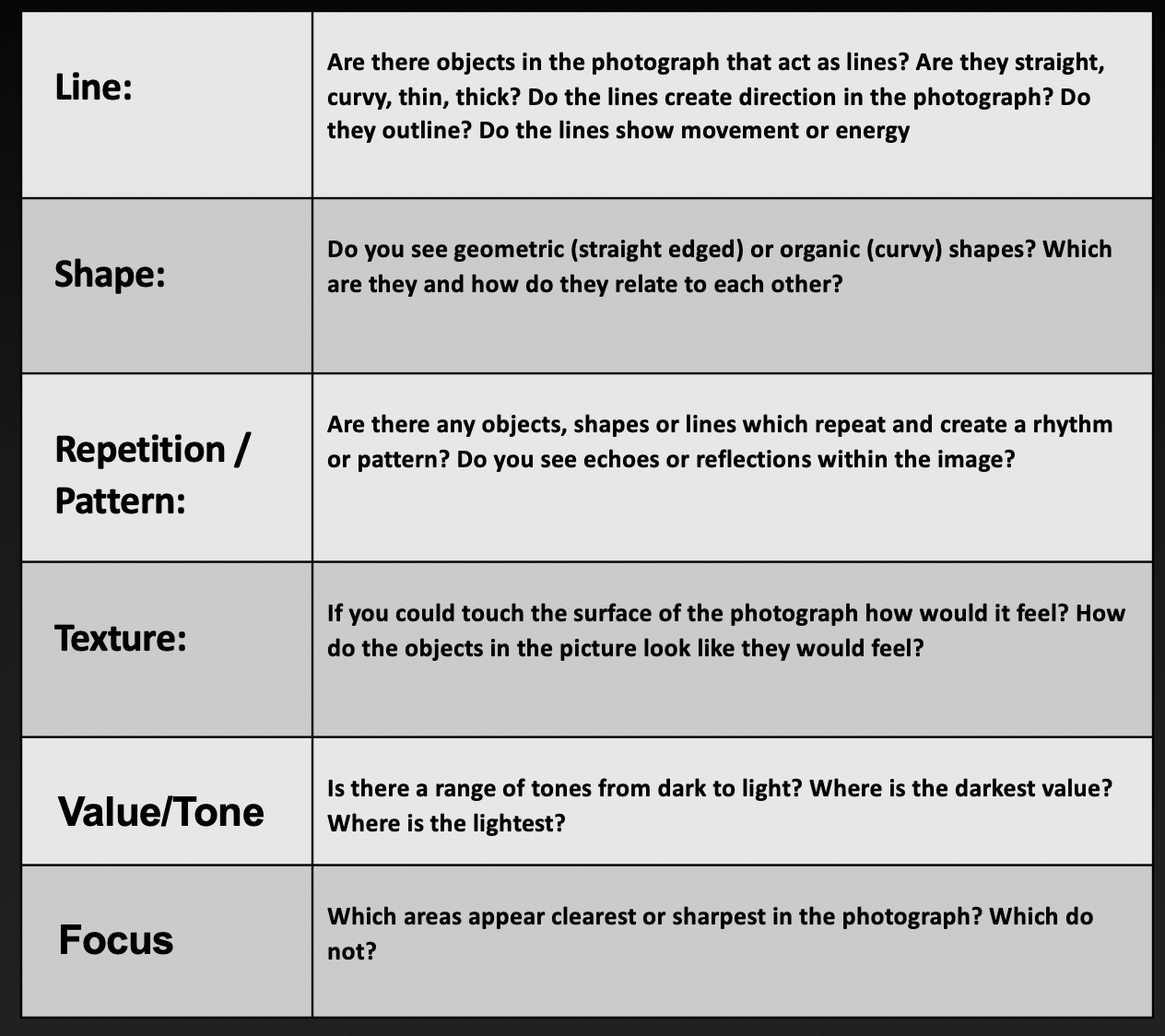
In this photograph, I think Aaron Siskind was trying to capture the elements of texture, shape, and value/tone. Siskind uses the formal elements of photography to emphasize the feeling of the passing of time and erosion by magnifying the texture of the chipping paint in the photo, making it the main focus. The shape of each peeling paint is unique, and without a specific pattern, this creates a better connection with the real world as a realist abstract photographer. The black and white in this photograph illustrates a strong contrast between chipped and unchipped paint, enhancing visual depth and giving it a better sense of dimension and layer.

Works Cited:

Siskind, Aaron. “Peeling Paint, Jerome, Arizona | the Art Institute of Chicago.” The Art Institute of Chicago, www.artic.edu/artworks/22556/peeling-paint-jerome-arizona.


Formal Elements of Photography-Blog Post 4

I think it is very hard for an image to have just one element at a time because the elements are all interconnected. A simple line can be viewed both as a “line” and as a “shape”; a group of lines can be observed as a pattern. For example, the photo below features many repeated lines/rectangular shapes. The center also has the lightest value, bringing the focus of the eyes to the center of the photograph.

Andreas Gursky, “Times Square, New York”,  1997


Works cited:

“Andreas Gursky. Times Square, New York. 1997 | MoMA.” The Museum of Modern Art, www.moma.org/collection/works/55649.

Researching the Starting Point

The pictorialism movement in the 1850s emphasized the beauty of photography over accuracy, transforming it from a scientific representation to a form of art. It focused on the aesthetic components and aimed to make everything look and feel dreamlike and romantic. Photographers used techniques such as the “dark room” techniques and added additional brush strokes to further enforce a painting-like effect. Straight photography, on the other hand, was completely different from pictorialism; it valued authenticity and honesty over beauty. The photos clearly captured the sharp edges and intricate details of the image, rather than a smooth, soft atmosphere.


Aaron Siskind, “Jerome, Arizona 21”, 1949

Edward Weston transformed his photography style from soft, painterly to sharp and focused. He moved on from pictorialism to pursue a more abstract side of photography and inspiring the idea of “straight photography.” Similarly, Siskind emphasized the different elements in photographs, such as the texture and lines of objects instead of soft images that are seen in pictorialist photographs.

Field #9, 1995, Uta Barth. Chromogenic print. © Uta Barth

The contemporary artists Uta Barth and Andreas Gursky create abstraction in a special way as modern photographers. Barth coveys themes spiraling around the ideas of “perception, optical illusion, and non-place” (Wikipedia contributors). I think she incorporates both straight photography and pictorialism in her artworks, as seen in the blurred backgrounds and her usage of different lights. Andreas Gursky captures images filled with different colors of modern society. I personally think Gursky’s work is far from pictorialism and follows the patterns of abstract straight photography, as he likes to digitally restructure his work to highlight visible abstract patterns.

Works cited:

“Aaron Siskind Photography, Bio, Ideas.” The Art Story, www.theartstory.org/artist/siskind-aaron

Anthony, Jordan. “Edward Weston – Explore the Edward Weston Photography Style.” Art in Context, 7 Aug. 2023, artincontext.org/edward-weston

“Andreas Gursky.” Gagosian, 29 Jan. 2026, gagosian.com/artists/andreas-gursky

“Pictorialism Movement Overview.” The Art Story, www.theartstory.org/movement/pictorialism

“Straight Photography Movement Overview.” The Art Story, www.theartstory.org/movement/straight-photography

“Uta Barth.” Tanya Bonakdar Gallery, www.tanyabonakdargallery.com/artists/29-uta-barth

“Uta Barth: Peripheral Vision.” Getty Museum, www.getty.edu/art/exhibitions/barth

Wikipedia contributors. “Aaron Siskind.” Wikipedia, 29 July 2025, en.wikipedia.org/wiki/Aaron_Siskind

Wikipedia contributors. “Andreas Gursky.” Wikipedia, 12 Dec. 2025, en.wikipedia.org/wiki/Andreas_Gursky

Wikipedia contributors. “Uta Barth.” Wikipedia, 23 Jan. 2026, en.wikipedia.org/wiki/Uta_Barth


Definition- blog post 2

I think abstract photography is focusing on the different elements in an object or space and exploring ideas indirectly and creating feelings instead of documenting the complete truth.

Starting point- Blog post 1

Abstract photography can be defined as capturing images in which the subject isn’t the most interesting element. Albert Renger-Patzsch and Aaron Siskind photographed the ordinary to reveal their beauty. Uta Barth reversed the typical use of the camera, shooting out of focus and Andreas Gursky photographs the repetition of elements. During this unit, you will investigate appropriate examples of abstract photography and respond in your own way.”

I think this means that abstraction techniques magnify the elements surrounding the subject and manipulate the background more than the subject itself. It draws attention to the shapes, textures, and patterns more than composition and the “traditional” rules of photography. I think abstraction gives each individual greater creative freedom in choosing what and how to capture each photo and drawing more attention to the elements that are sometimes not noticed.

© 2026 Alyssa

Theme by Anders NorenUp ↑

Skip to toolbar