


SONY DSC

SONY DSC


Katerina Plotnikova’s introduction into photography was more ordinary than most. She had been painting since she was young (around 6 years old), with a form of art already being constant in her life. Later on, she enrolled in a university with a specialization in advertising design. This is where Plotnikova was initially introduced to the world of photography, which was part of the course load. Her passion for painting helped her discover her own voice in photography, something that she claims is “still prevalent in [her] life to this day.”
She finds inspiration for her work from a multitude of places. It is not uncommon for Katerina to visit home improvement and hardware stores to find inspiration. She also travels to flea markets to find inspiration for her photography. Secondhand stores, and even garbage bins, are all on her list of places of inspiration. Despite her wide variety of inspirations, she still finds nature more intriguing than anything, especially landscapes. Her work is influenced by photographers Tim Walker, Annie Leibovitz, and Adam Smith, with whom Katerina looks up.

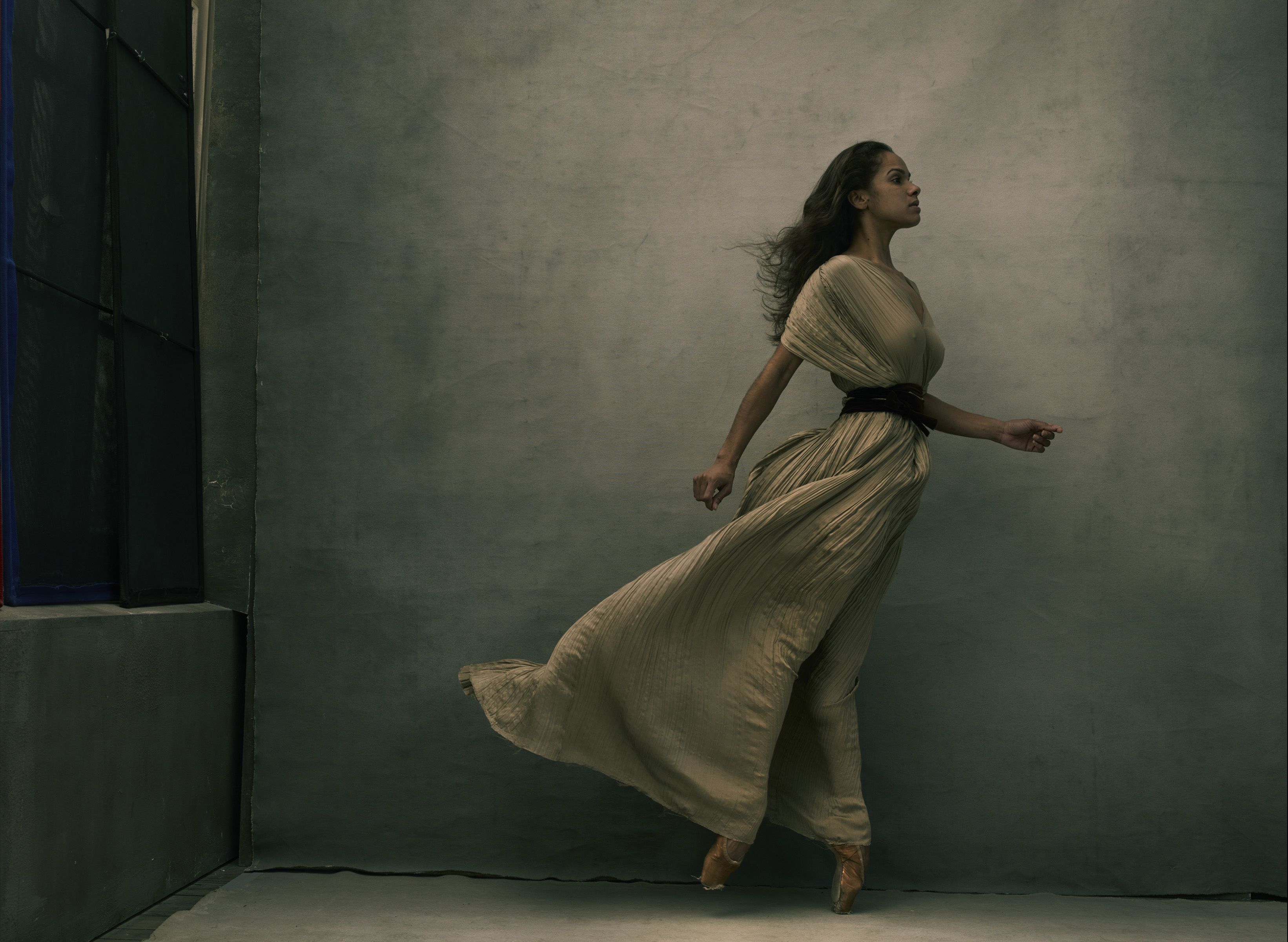
There is a clear resemblance between the works by these photographers and Katerina’s own work. She also commonly uses a front-on lens, where she photographs her character’s head on instead of using angles. Katerina makes a deliberate choice of colour in the clothes the model is wearing, taking into account the animals, as well as the model’s skin, hair, and eye colour, to complement the image. This is evident in the image taken by Tim Walker. Despite the composition being standard, the affinity between the colours of the model’s hair, the clothes on her back and the flowers complements the image perfectly. The inclusion of emphasis on subtle emotion in the model’s features makes for an outstanding image. There is also a resemblance between Annie Leibovitz’s work and Katerina’s. Leibovitz employs soft lighting and strong representations, with some images featuring a dark ambiance, as seen in the provided image. This is starkly similar to many of Katerina’s own works, some of which borrow a similar lighting and style but with the inclusion of animals.

This photograph by Katerina Plotnikova embodies many of the qualities that define her work: a blend of
Colour plays a central role in shaping the photograph’s mood. The model’s vivid red hair spreads across the frame like a glowing halo, while the snake’s orange scales echo that warmth in a subtler, patterned way. These warm tones contrast dramatically with the cool aqua-blue of the dress, creating a complementary colour palette that feels both striking and harmonious. The greens of the grass and wildflowers act as a subdued backdrop, allowing the key colours to stand out without competing for attention. Plotnikova’s colour choices feel deliberate and painterly, connecting to her background of art and giving the scene the visual richness of a storybook illustration. Her photos often have a mystical, artistic feel to them.
The composition is equally deliberate. The model is centred, her pose calm and symmetrical, while her hair creates an organic, spiralling frame around her head. This specific composition brings attention to the model, but the quick attention snag is smoothed out by the more organic and shapely way the model’s hair fans out around her face. The snake becomes a compositional line, forming a gentle S-curve from her forehead down through her hands and into her lap. This fluid shape guides the viewer’s gaze naturally through the scene. Instead of tension or fear, the model’s relaxed grip and steady expression suggest acceptance and connection, allowing the serpent to feel less like an intruding creature and more like an integral part of the image, further solidifying the idea of connection to nature.
Perhaps the most striking element is the harmony between the model and the snake. In typical Plotnikova fashion, the human-animal relationship is depicted not as threatening but as intimate and mythic. The serpent’s coloration blends beautifully with the model’s hair tones, making it seem like an extension of her presence rather than a contrasting element. The calmness of the pose, the softness of the light, and the careful placement of the snake all contribute to the sense that girl and serpent exist in a shared, symbolic stillness.

For this portraiture project, my intention is to explore emotion as a visual language. I plan on using highly expressive and exaggerated angles and poses to convey the individuality of each person. I want each portrait to feel dramatic, confronting, and memorable—capturing emotions at their peak rather than in subtle or understated forms. I want the image to represent each person’s unique personality through the photo and the nature of humanity.
To achieve this, I have used a range of technical approaches throughout my work. I experimented with controlled lighting setups, primarily exploring the relationship between soft light and the controlled angling of the camera. In one of the practice shots. I plan on reusing that technique in my final as well. I used a wide lens to attempt to exaggerate a perspective further to achieve the desired effect. I incorporated mixed-media techniques by digitally editing and drawing directly onto the photographs, mainly through Procreate. This allowed me to exaggerate expressions even further—emphasizing contours, adding expressive marks, and enhancing emotional tones. These hand-drawn elements create a bridge between photography and illustration, highlighting the psychological intensity I aim to portray. With such an emotional representation, I plan to add extra elements. For example, wings sprouting from the back of one of my character’s subjects, or replacing another’s face with a cat’s head to portray a lonesome and independent personality.
Ultimately, I aim to enhance the expression of emotion and personality in each individual.
Technically, a portrait is defined as a photo taken of the head and shoulders, essentially a bust. However, a portrait can also be an image of someone’s feet on a skateboard or an extreme close-up of a person’s face. Despite the standard definition, I believe that a photograph can be considered a portrait when it is taken with a specific purpose, often in the form of close-ups. Unlike other forms of photography, such as street photography, portraits are frequently deliberate in their intent and convey a deeper, intended meaning.


For example, the images above are both portraits. Neither of them fits the generic definition of a portrait, such as those taken during the early beginnings of photography in the 1800s, but both are still considered the same type of image. Portraiture shouldn’t have a hard definition; what constitutes a portrait or not should depend on the meaning of the image, rather than its appearance.
Selfies are similar to portraits, but not quite the same. The technical definition is that selfies are taken primarily for the purpose of sharing on social media and to document personal lives. While a portrait can serve a similar purpose, a portrait should always hold a deeper meaning beyond documenting a singular moment. Most portraits are symbolic of deeper concepts, like gender roles or psychology. As for what content is in the portrait, there’s an extensive list. Of course, for a good portrait, the composition should be nothing boring. It should aim to strike the viewer, to make them think. For example, a generic, almost glossy or AI-generated feel should be absent from a good portrait. However, portraits are extremely open-ended, and there aren’t any true limitations to what should or should not be included in a portrait.
A portrait doesn’t necessarily need to contain a lot to be striking. A close-up shot of an eye, for example, can be just as inspiring as a full-body shot. It’s the details and the composition that count. Let’s take the close-up photo of an eye as an example. What’s reflected in the pupil and how the light is directed matter more than how much is projected. The life and deeper representations of an image are always in the details and not in how much content you can cram into a singluar photo. Photoshop or multimedia additions made after the photograph is initially taken can go a long way in enhancing an image as well. Despite the open-ended nature of a portrait, something that strays too far into abstract territory crosses the very vague limitations of a portrait. A figure that is too blurred, blurred to the point where it is difficult to identify whether it is a human or not, is considered abstract and not a portrait. Portrait images, despite the vast range of formatting options available, still have boundaries. The subject still needs to appear human or resemble the intended object, so it is not mistaken for something else.
A representation shouldn’t be limited to a person or an animate being, even if it is the “definition” of a portrait. For example, the “Hotel” series by Sophie Calle is composed of inanimate objects, yet still manages to depict the presence of life through personal belongings. The meaning is present, and signs of life can be taken off of these belongings, like a carelessly thrown shirt or journals.

A portrait is not limited to a singular photograph. Because of how well creative aspects play into portraits, photographers are able to portray a single image as a composition of multiple images. For example, Nick Gentry creates humanoid people through the use of other media. It is a clever way of incorporating other images to form a single, unified portrait. The creativity of the image makes the portrait stand out, and breaks the genaric barrier that a photo must be, at all times, a singluar photo.


Before

After


Before

After

Before


before

after

before

after

© 2025 Catherine
Theme by Anders Noren — Up ↑


Recent Comments