The message of my triptych will be to encourage and trust technology. Technology is everywhere, and it has art in the complex mechanics. I want the audience to appreciate the beauty of the futuristic environment and to feel inspired and ready to learn when looking at my presentation. For inspiration I will try to find a photographer who explores big cities, finding beauty within our new world. I want to find photographs that lines that clearly define the photo. In my opinion, we have to respect and praise the technology and the future that is in front of us. Technology is helpful and can help us out of tight situations.
Daniel
"I have no special talent. I am only passionately curious" - Albert Einstein
The message of my triptych will be to encourage and trust technology. Technology is everywhere, and it has art in the complex mechanics. I want the audience to appreciate the beauty of the futuristic environment and to feel inspired and ready to learn when looking at my presentation. For inspiration I will try to find a photographer who explores big cities, finding beauty within our new world. I want to find photographs that lines that clearly define the photo. In my opinion, we have to respect and praise the technology and the future that is in front of us. Technology is helpful and can help us out of tight situations.


1: Contrast, one side is dark while the other is light
2: Shape, there is a clear square
3: Pattern and texture, the dots/lines are clear
4: Pattern and line, there is dark and light, and they are alternating
5: Line, there is 2 lines that are emphasized
6: Shape, there is a clear circle
7: Shape and line, there are clear defining lines, and there are squares
8: Pattern and shape, there is a pattern of circles
9: Line, shape and pattern, there are clear lines that create quares
10: Contrast and line, the lines define a clear dark or light part
11: Contrast and shape, there is a clear trapezoid
12: Line and texture, you can see the grooves, and they are all horizontal
Down below, I think that photos 5-11 all turned out very well, because I applied filters and made them look very interesting. The other photos also captured the drawings, just that they dont have decoration and are a bit standard.


.jpg)
The photographer may have wanted to capture 3 of the elements:
Repetition: The curved linew make a spiral towards the center, guiding the eye towards the middle of the picture
Shape: The shape is a nice spiral, upright, and you can see the curves in the middle of the shell
Value: The upper-right part of the shell is a very bright white/silver, the lower-left part of the shell is gray, and the negative space is very dark, and there is a lot of contrast.
If I was the photographer, I would have named it Birth, because I can see how the dot in the center gives birth to a spiral, that slowly gets bigger and bigger.
Weston, Edward. Shell. 1927. WikiArt.org, www.wikiart.org/en/edward-weston/shell-1927-1.
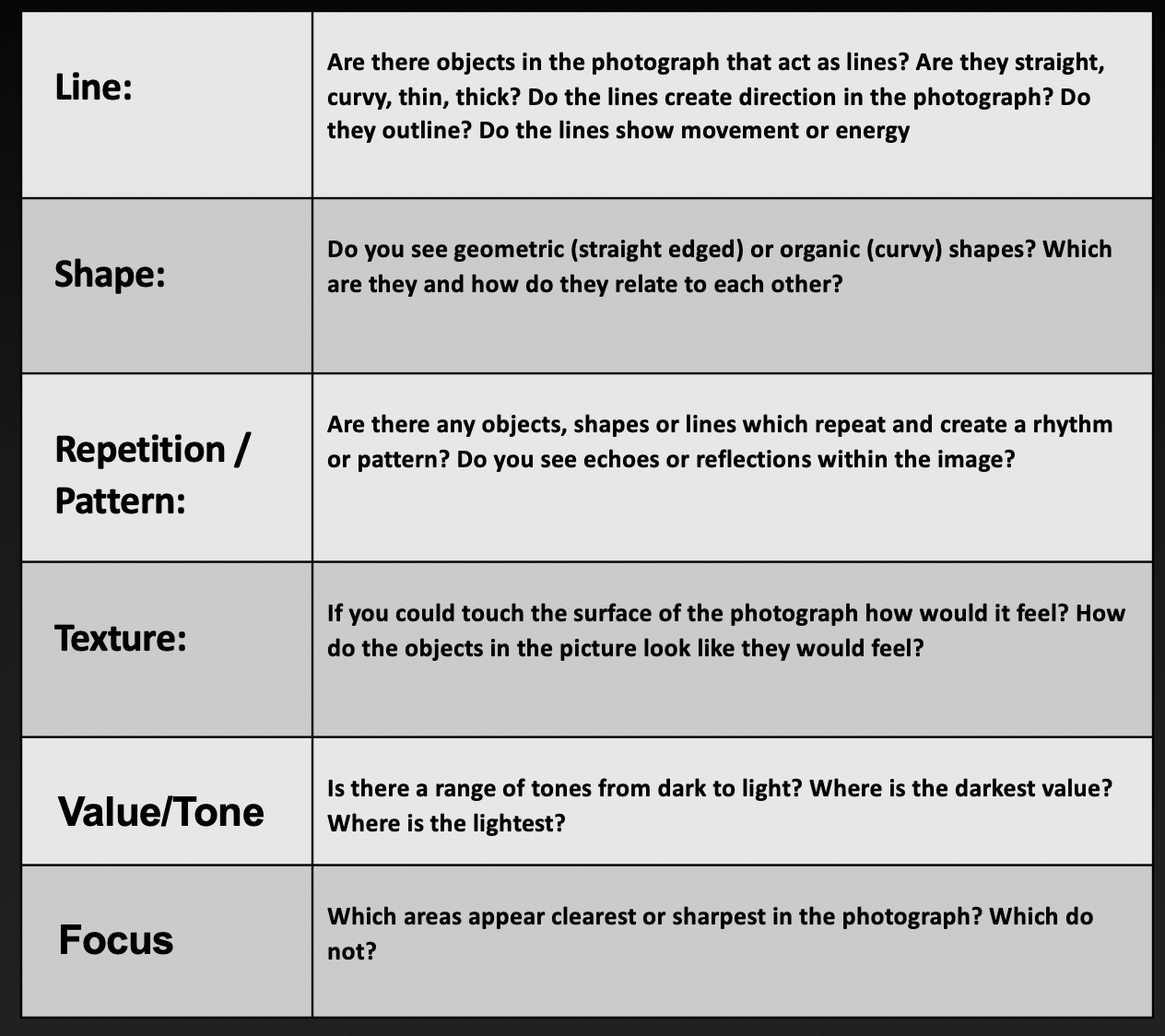
Yes, is is possible to have only one element, such as photographing a piece of sandpaper, but a photograph that only captures one element may not be a ‘good’ photograph.
Pictorialism was the movement in photography that emphasized the beauty of the photograph, and wanted to compare to the other arts, such as painting and drawing. They wanted to show the real art in photography, and have it recognized as another branch of art. They intervened in the photographic process by smearing Vaseline on their lenses, and smashing their camera lenses. The aim was to make photography an art process, just like other forms of art.
Straight photography was the idea that photography should use its unique qualities as a form of art, such as the sharp detail. The term straight refers to the untouched beauty of photography. It embraced modern ideas, such as contrast, and sharp detail.
Aaron Siskind and Edward Weston’s photographs both have very high amounts of detail, and they also have lots of contrast, having dark areas right next to bright areas.
Andreas Gursky and Uta Barth’s photographs do not have a real clear meaning, and they are not trying to exactly capture the detail of the picture, instead trying for there to be beautiful colors, or flowy patterns, that may appeal to the viewer’s eye. These pictures are also not taken with the standard, traditional methods, such as being out of focus.
Abstract photography can be defined as capturing images in which the subject isn’t the most interesting element. Albert Renger-Patzsch and Aaron Siskind photographed the ordinary to reveal their beauty. Uta Barth reversed the typical use of the camera, shooting out of focus and Andreas Gursky photographs the repetition of elements. During this unit, you will investigate appropriate examples of abstract photography and respond in your own way.
I think that the point of Abstract photography is to introduce new concepts and ideas to the photo, such as mistakes, or other highlights, etc. It is meant to be interesting, or have some hidden meaning, instead of just capturing the subject. People may not be used to seeing them, and they may be classified as weird. Abstraction is about hiding a meaning, or blurring the subject, to create a beautiful photograph. You need to find a way to warp reality, and create a personal meaning within the photograph.
Things wrong with the picture
– Not following the rule of thirds
– Person right under tree
– Out of focus
– Man is camouflaged
Can a bad picture ever be great?
How important is context in photography?
We see pictures as they are, and we find some that mean things to us. Because we see just the picture, the picture matters more to us, but if there would be other pictures, or context, we would be more interested just the story. On the other hand, if pictures did not have context, if they did not mean anything to us, we might just ignore it, even though it has a deep meaning behind it. Context simply helps us understand what is going on in the picture.
Sources
https://www.lomography.com/magazine/353974-in-depth-is-context-important-in-photography#:~:text=Context%20is%20not%20mandatory%20%E2%80%93%20but,put%20oneself%20in%20another’s%20shoes.


© 2026 Daniel
Theme by Anders Noren — Up ↑
Recent Comments