Jio

"I have no special talent. I am only passionately curious" - Albert Einstein

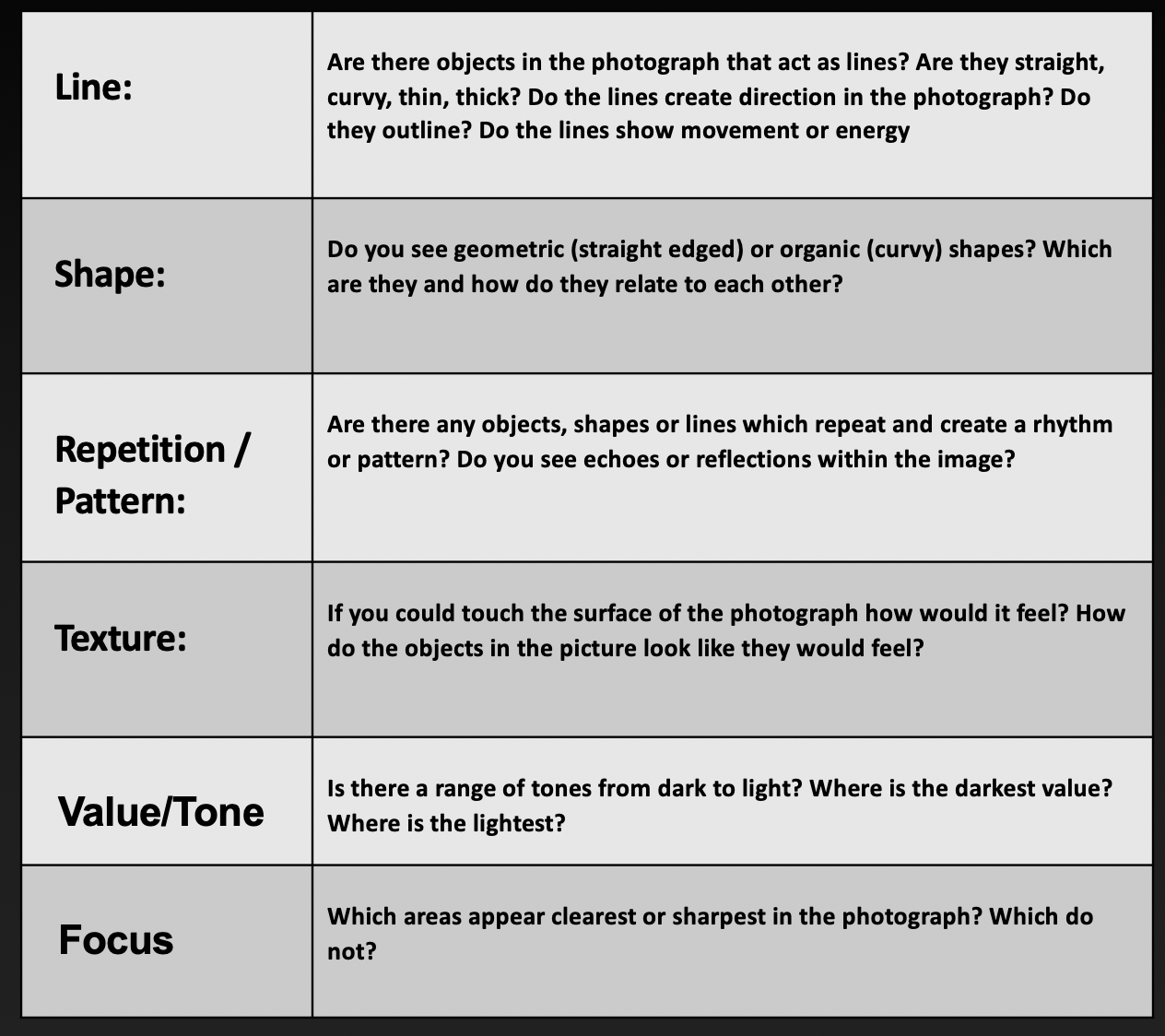
Blog Post 4: Formal Elements of Photography

Photos are usually formed with several different elements of photography. In some cases, they can be formed with just one element. An image can show just one element if the photographer uses composition techniques like focus, lighting, and a simple background to draw attention to a single subject. Even if other details are present, they are made less noticeable so the viewer mainly sees one clear element.

Blog 2 Contact Sheet

Blog Post 1&2 Starting Point

Abstract photography can be defined as capturing images in which the subject isn’t the most interesting element. Albert Renger-Patzsch and Aaron Siskind photographed the ordinary to reveal their beauty. Uta Barth reversed the typical use of the camera, shooting out of focus and Andreas Gursky photographs the repetition of elements. During this unit, you will investigate appropriate examples of abstract photography and respond in your own way.

Unlike normal photography, which focuses on the person in the photo, an abstract photo doesn’t focus on the subject. Instead, it focuses on other elements in the photo, such as shape, color, texture, and movement. It becomes more about visual impact and interpretation rather than identification. It focuses more on the background and surroundings.

P2

Anything can be considered an abstract photo. The beauty of abstraction can be found in anything and anywhere. If the photo is focused on the visuals, such as movements, colors, and shapes, they can be abstract photos.

Wrong!

In Wrong!, Baldessari shows a photograph of a man standing in front of palm trees, but the way the picture is arranged looks strange instead of nice. Instead of placing the man carefully and in a balanced way, Baldessari positions him awkwardly in the frame. His head lines up directly with one of the palm trees, making it look like the tree is growing out of his body. This makes the image feel uncomfortable and slightly wrong to look at. Rather than trying to make a beautiful or professional-looking photograph, Baldessari purposely breaks common photography rules, especially the rule of thirds. This rule says that important parts of an image should be placed along certain lines in a three-by-three grid to make the picture look balanced. By ignoring these rules, Baldessari seems to be making fun of traditional photography standards while also questioning why artists are expected to follow them. His approach feels both playful and thoughtful because he intentionally creates what looks like a mistake and then highlights it by naming the work Wrong!. This title encourages viewers to rethink what actually makes a photograph good or bad. The black-and-white color of the photograph also supports Baldessari’s idea. Because there is no color, the image looks plain, dull, and less emotional. This makes viewers focus less on beauty and more on how the picture is arranged. In addition, the low contrast makes it hard to clearly see the difference between the man, the house, and the palm trees. Instead of standing out, the man blends into the background, making the image look flat and unclear. This can make the photograph feel confusing. Normally, this would be considered a mistake in photography, but here it seems intentional. By making the image look unclear and imperfect, Baldessari emphasizes that the photograph is meant to be “wrong.” At the same time, he challenges the idea that all good photographs must be sharp, clear, and perfectly composed. 

Baldessari, John. Wrong, 1967. WikiArt, https://www.wikiart.org/en/john-baldessari/wrong-1967. Accessed 18 Jan. 2026. 
Humanism infographic

Humanism

https://www.canva.com/design/DAGUwngsAq4/w3Gxr7EQSJ5kqbvHlLHeIg/view

My side of the story

Injustice in the main character’s family. 

This story has two conflicts, sibling war, and injustice. Firstly, sibling war. Sibling war is a human vs human external conflict. In the beginning of the story, the main character’s brother starts a fight by putting scotch tape on the main character’s head while he is working. The main character tries to take it off, but it was too late. So, his brother pretends to help and rips off the tape hard and rips his hair off. This makes the main character frustrated. The main character runs to his mom’s room to tell her what happened. He bursts into the room expecting his mom to be there. However, his dad was in the room working. His dad gets mad that he didn’t knock on the door. The main character tries to explain what happened to him. But his dad ignores and just scolds him. The main character already got bullied by his brother several times but no one in his family supports him. His mom and dad all support his brother. It is not fair for the main character. The main character’s dad does not care about the main character’s perspective. He only focuses on scolding him. His dad is on his brother’s side, so his dad doesn’t care what happened to him. 


My poem explains about how the main character is upset about the situation. The main character wants justice in his family, but his dad only cares about his perspective. My poem explains the challenges.


Citation: file:///Users/jio.jung/Downloads/My_Side_of_the_Story-student_copy%20(1).pdf


Poem: https://www.canva.com/design/DAGO6e5qG_A/ArqD3Toz-uZjltchP-dh4Q/edit

Welcome to Your New Blog!

When you blog you create posts and posts are categorised according to your subject. Some categories have already been set up for you. If you need more categories you can add them as needed. It’s important that your posts have the following:

  • An engaging title – this should not include the name of the subject since this is referenced in the category.
  • Body – this is where you share your learning. This can include text, images, embedded videos from Dragons’ Tube or elsewhere. You should always consider how your post looks to your audience. Is it engaging? Do they want to keep reading?
  • Category – select one that has been set for you or add a new category. Posts can have more than one category e.g. Humanities and Myself as a Learner

Click on the images below to learn more about blogging:


© 2026 Jio

Theme by Anders NorenUp ↑

Skip to toolbar