Pictorialism Movement
The Pictorialism Movement in photography emerged as a photographic style in the late 19th century. It emphasized artistic interpretation over literal representation and made use of soft focus which created dreamy, atmospheric images.
Straight Photography Movement
The Straight Photography Movement in photography made use of large format cameras producing highly-resolutioned images. It employed small apertures which created a deep depth of field and also practiced precise exposure and the development of techniques. The Straight Photography Movement also explores abstract compositions and unconventional perspectives.
Pictorialism Movement vs Straight Photography Movement
The difference between Pictorialism Movement and Straight Photography Movement in photography is that Pictorialism Movement is aimed to make the photos look like paintings by using soft focus and manipulation while on the other hand for Straight Photography Movement, it is aimed to embrace sharp focus and unaltered images.
The Straight Photography Movement became popular amongst photographers in the years of the early 20th century because it focused on capturing sharp, clear images that captured reality directly. This was contrast to the Pictorialism Movement which used artistic manipulation to soften photographs. Photographers likeAlfred Stieglitz and Edward Weston moved away from the manipulated, soft focused part of photography and looked for clarity in their work since they believed that photography should highlight the ability to present the world directly.
Since I did not see any photographs of Edward Weston, I went to search what photograph he was most known for. One of Edward Weston’s most famous photograph is called “Pepper No. 30” (1930) and one of Aaron Siskind’s famous photograph is called “Jerome 21” (1950). These two photographs are well-known examples of Straight Photography Movement. “Pepper No. 30” shows a close up of a pepper capturing its texture and shape in sharp detail. Aaron Siskind’s “Jerome 21” focuses on a weathered wall, turning its cracks and peeling paint into abstract art. Both photos highlight everyday objects with clarity and shows the influence of the Straight Photography Movement.

“Pepper No. 30” (1930) by Edward Weston
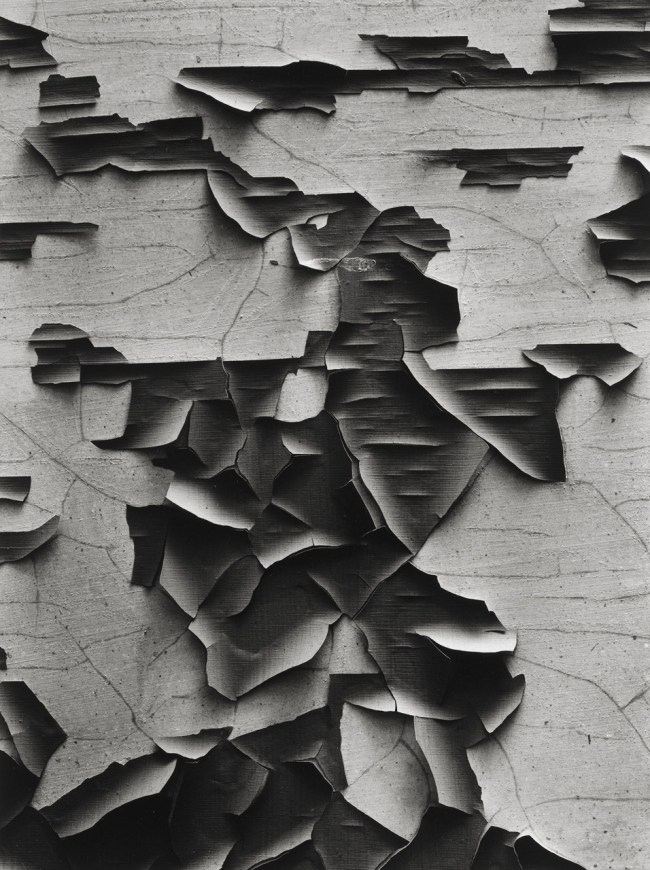
“Jerome 21” (1950) by Aaron Siskind
The works of contemporary photographers Andreas Gursky and Uta Barth is considered abstract because they focus on how we see things rather than showing clear subjects. In Andreas Gursky’s photograph “Rhein II” (1999), the photograph of the Rhine River is made abstract by its simpleness. The lines and colors are controlled, and the river looks more like a geometric pattern than a natural landscape. Uta Bartha’s photograph “Ground #57” (2002), uses soft focus and blurred details to create an abstract image. The photo highlights light and texture instead of showing a clear object. Both contemporary photographers make their viewers think about how they see the world, rather than what they are actually looking at.

“Rhein II” (1999) by Andreas Gursky

“Ground #57” (2002) by Uta Barth
In my opinion, Edward Weston and Aaron Siskind are more aligned with the Straight Photography Movement which focuses on capturing clear, sharp images of the real world without manipulation. Edward Weston’s work, “Pepper No. 30” and Aaron Siskind’s word, “Jerome 21”, emphasizes texture and form with a direct and realistic approach while on the other hand, Andreas Gursky and Uta Barth don’t fit into either the Pictorialism Movement or the Straight Photography Movement. I think this because Andreas Gursky’s work “Rhein II”, and Uta Barth’s work “Ground #57”, are more abstract photographs, using manipulation and blurred focus to explore perception and form rather than clear representation like Edward Weston and Aaron Siskind’s work. This makes their work more modern and conceptual rather than rooted in the traditions of Pictorialism Movement or the Straight Photography Movement.
Citations:
Fiveable. “Pictorialism Vs. Straight Photography.” Fiveable, 22 Aug. 2025, fiveable.me/american-art-between-1865-1968/unit-5/pictorialism-vs-straight-photography/study-guide/unaVDAajgeJA7MlH.
Luntz, Holden. “Edward Weston’S Pepper No. 30.” Holden Luntz Gallery, 31 Oct. 2020, www.holdenluntz.com/magazine/new-arrivals/edward-weston-pepper-no-30.
Wikipedia contributors. “Pepper No. 30.” Pepper No. 30 – Wikipedia, 25 July 2025, en.wikipedia.org/wiki/Pepper_No._30#/media/File:Pepper_No._30.jpg.
Aaron Siskind | Jerome 21, Arizona (1949) | Artsy. www.artsy.net/artwork/aaron-siskind-jerome-21-arizona.
“Uta Barth | MoMA.” The Museum of Modern Art, www.moma.org/artists/7827-uta-barth.
Leave a Reply
You must be logged in to post a comment.