Raymond

"I have no special talent. I am only passionately curious" - Albert Einstein

Category: Uncategorized

Pencilcase Blog Post

First design:

The end result of my product was derived from a series of ideas that led to my final design. The first prototype I chose to create began with me contemplating what type of product I would require the most, which I was also missing during that time. I decided that a ruler would be my top choice. I decided it would be around 15 centimeters long, with many decorations and patterns on it to make it look better. However, soon after designing this, I realized that a ruler would be too unchallenging and undemanding to create. Hence, I decided to change my design by redesigning my pencil case. Although I was not missing one at a time, I felt like I could make another higher-quality one that would also look better.


Second design:

          The second design is the first version of my pencil case. I decided on similar dimensions to the one I was currently using, around 16 centimeters in length, 4 centimeters in width, and 3 centimeters tall. On the exterior, I decided on a clean look, without many decorations. For the interior, I decided to create 3 compartments. the first, or the biggest, would contain the pens and pencils. The second, a smaller one, would hold the erasers. The last one would be the smallest, long and skinny, holding a ruler. I then moved on to the mechanics – how the case would open/close, how would the closed case stick together, etc. I decided to make the top of the case possess a longer width. This way, I could preserve the clean look, while giving it an easy way to open and close it. I decided on hinges that would connect the top and the backside. The hinges would also be small, also in the goal of preserving the clean feeling of the case. Lastly, I settled on magnets that would be stuck on the interior of the top of the case and the bottom. This way, the magnets would hold the box together when closed, and prevent it from spilling its contents if it was accidentally opened.


third design:

          However, soon after I made the isometric view, I realized that it looked too clean – bland and mundane. This caused the case to enter its next design stage. I decided to counter the product’s blandness with multiple decorations. I decide on geometric patterns, which after I drew on the model, found that it suited the case very well. I would preserve the other features of the case, such as the stain, the compartments, the magnets, etc.


Final design:

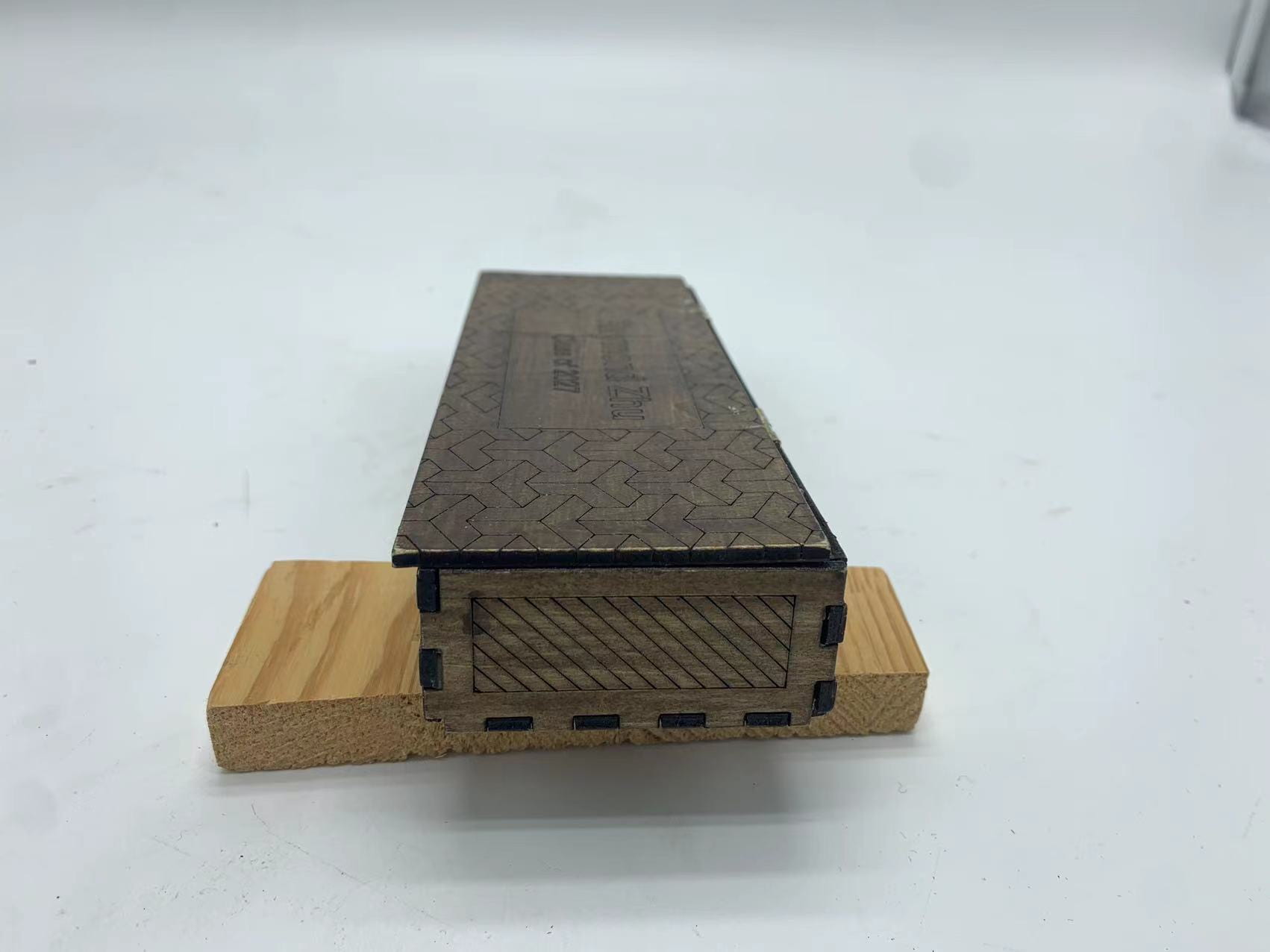
            I decided to stick to this version to create my first paper prototype of it. It came together nicely, however, I realized that the case would be far too small to be efficient and effective at carrying my supplies. So, I decided to enlarge my case with a scale factor of around 1.2.  This decision would bring me to my final design. After expanding the dimensions of the box, I created it inside Fusion and printed it. After I assembled each of the parts, I found no errors with the design, only small ones such as mistakes I made while creating the individual parts in Fusion. After fixing it, I printed it in wood, stained it, and assembled it.


Summary:

Overall, I would rate my final product 9/10. It solved almost all my issues with carrying pencils and other tools, and the exterior including the interior looks great. However, the reason why I removed the final point is due to errors I made while assembly. Many of the wood pieces, after laser cutting bent, which is still apparent in my case if you look hard enough. Another is the inconsistency in the staining process. Many parts are lighter than others. It also caused the case to become sticky, which less than before, can still be felt on the texture of the case. Lastly, I rushed the assembly of the individual parts, which led to many errors, such as the nails, which broke some small parts of the surface of the top cover off, along with me using hot glue for magnets, which caused a big glob in the place where the magnets currently rest.


What skills did I grow during the process of designing and creating?

          I grew and developed many skills during the process of designing the pencil case. The biggest skill that I grew is definitely my ability to plan products in stages, or my problem-solving skills. My plan required multiple design stages, which taught me how much design stages impact the final look and feel of the product. However, there were also many challenges and obstacles among the way, which made me think about them and solve them. The second skill I grew was learning new software. In this case, fusion. I learned many different ways of creating different shapes and adjusting them, which allowed me to create my pencilcase. The tools involved with creating those shapes will be no doubt very useful for me in the future. The final skill I grew was assembly and staining. This project was the first time I had ever done both, meaning that it was an entirely new experience for me to learn from. I used to think that assembly would be the easiest part of all of them, however, I quickly learned the hard way that it would be one of the hardest. In the planning and design stages, if something went wrong such as a measurement or angle, you could adjust it back. However, there would be no room for adjusting a mistake in assembly and staining, as they are permanent. Nonetheless, I have learned from this process, and now I understand it well enough to make fewer inaccuracies while designing and assembling a product.


Reflection on my product:

  • What tips and tricks will I give to the upcoming PD students next year?

There are many tips I would want to give the upcoming PD students next year. The first would be to plan ahead. Planning ahead is an extremely important step in designing a good product. It allows you to see what you want to create before you even start, allowing you to make the process of designing and creating a lot smoother whilst making your product higher quality. Planning ahead also allows you to see future obstacles that may get in the way of creating your product, which makes it easier to find solutions to them. Another tip that I would give is to contemplate whether or not your design will be good for long-term use. If the design of the product is based on something which you may lose interest in, you may dislike the product and ultimately stop using it. A way around this is to contemplate the most essential tools you have used almost every day for the past few years, (for me, a pencilcase) and think how you can redesign it to better suit your needs.


  • What would I do differently if I was given the chance to restart from scratch?

If I were to restart from scratch, the first thing I would do is to correct the unseen mistakes that I made while designing my pencilcase. For example, I would rather have sanded the wood before I stained it, as it would make the wood much smoother and more appealing. I would also correct some design mistakes that I made on Fusion. For example, I did not consider the corners of the case when I applied the fingers, leading them to create a small empty space.

  • What do I want to change or add to the course that would make it better?

    More time would be much better, especially in the final few classes. I think we could spend less time studying creating the isometric view and the paper prototype, as although they were useful things to learn, they took a lot of time and classes that I think would be more beneficial for fleshing out the final product.


     A young Cuban child holds his Fathers hand as he walks down the busy streets of Havana. Completely mesmorized by the people and sounds. Little did he know, that the events that would happen later this very day on this very street, would ignite a fiery flame in Cuba from within, catipulting him down a cliff of revolution and revenge that would forever change the history of Cuba.

     The Cuban revolution was a period of bloody conflicts between the people of Cuba and the government which took place in the 1950s. Although many see revolutions as a whole as unneccesary, bloody, and pointless battles that only lead to more deaths, the Cuban revolution actually led to several  significent and good changes in Cuba such as politics, economics, which still impact Cuba today. The Cuban revolution started on March 10th, 1952, where the former president of Cuba, Fulgencio Batista, led the Cuban Constitutional Army into staging a Coup d’etat, killing many in the process as well as overthrowing the government and becoming dictator of Cuba. What followed next was 7 long years of corruption and the brutal oppression of the lower class, where almost 20,000 Cubans were killed by the hands of Batista. However, these 7, long years also ignited the flame of revolution inside Cuba. Following Batista’s escape to the US and the Rebel victory in Havana, a man named Fidel Castro was installed into power. Unlike Batista, Fidel Castro instead used his power to try and rebuild Cuba from the ashes of what Batista has left it as. He began turning Cuba into a socialist state, starting with the redistributed land to the peasants, then reformed Cuban healthcare and education systems, emphasized womans rights, promoted gender equality, etc. However, although he made several great reforms, he also soured relations with many countries, such as the USA, which led to an invasion in which Fidel Castro quickly repelled. Although he made several mistakes which threatened Cubas into war with the USA, many of the reforms that he made are still exists Cuba today, showing us just how significent those reforms are.

Analyzing key parts of the book “Shackles of the Deep”


Above are the notes that I have taken about central ideas and themes in the book Shackles of the DeepThe book Shackles of the Deep revolves around the rediscovery of the slave ship The Henrietta Marie, and follows the research of this particular ship as well as the transatlantic slave trade itself done by the main character, a black scuba diver. The main character travels to many different places to research this ship, and ultimatly uncovers many different secrets and hidden legacies about the Henrietta Marie – as well as the Transatlanic slave trade itself. Although the book was very informational and taught me many things that I have previously not known; it was structured in a way where it felt repetitve, such as the main characters travels to different locations to research about this ship, which made this book a slightly boring read.

I feel like I did not do as well on my notes as I could have on it. I wrote it sort of in a CER manner, which makes it dull and boring to read. Instead, I could have used the tactics we learnt in class, such as mind maps, charts, etc, and mixed it up with my current notes, which will make it much more interesting, and less “Cramped” to read. By doing that, I could also make it easier to understand what I am thinking, and lessen the amount I have to write, whilst being better.


Bluetooth speaker summative blog post

Hi, can you please see the email I sent you of the pictures? I cannot post my pictures into the blog post so I sent an email.

Overall, I think my speaker is a success. Why? Because it looks almost that exact same as the picture I head in my head from the start of this project. I wanted a stained speaker that would make it seem more modern and expensive, and a cover to make it look better and even more modern. The thing that was most importent to my speaker design was the cover. It made my speaker more unique as well as make it look better. My cover is also the thing that was hardest to make during this project. I had to stain very tiny parts and glue them together,  and it was very hard to try not to let the glue show. After I made the cover, I had to put it on the speaker. That was the part where I screwed up on. I accidentally put the cover too much on one side, which made it have a huge part sticking out in one corner. If I had the chance to redo my speaker, I would put it on more carefully. Some skills that I have learnt during this unit is making things fit with each other as well as how to make things unique from the other. 

Overall, I think my speaker is a success. Why? Because it looks almost that exact same as the picture I head in my head from the start of this project. I wanted a stained speaker that would make it seem more modern and expensive, and a cover to make it look better and even more modern. The thing that was most importent to my speaker design was the cover. It made my speaker more unique as well as make it look better. My cover is also the thing that was hardest to make during this project. I had to stain very tiny parts and glue them together,  and it was very hard to try not to let the glue show. After I made the cover, I had to put it on the speaker. That was the part where I screwed up on. I accidentally put the cover too much on one side, which made it have a huge part sticking out in one corner. If I had the chance to redo my speaker, I would put it on more carefully. Some skills that I have learnt during this unit is making things fit with each other as well as how to make things unique from the other.


Bluetooth speaker turn in

Bluetooth speaker design

My Design

The hardest part in the design was probably finding the lengths I needed to stick the two parts together, (the cone and the cylinder) and the spinning knife inside it. The spinning knife part was hard because I needed to hot glue it, and it was hard for the knife to spin without the two parts sticking together. Some thing that I would like to change is add supports, because it’s very hard to put it on a bottle/cup. I also need to make it look better, because there is basically nothing on it. The cylinder on the top is also slightly larger than the cone, so it makes it look ugly. By creating the project, I have learned several skills like how to ‘Visualize’ things better, so I can see the basic shape or length that I need to cut. Overall, this project feels kind of successful, but there are still several flaws to the design that I need to fix.

Our cardboard arcade game-Skeeball

Our cardboard game’s biggest obstacle in the making was the mechanism in which the ball rolls out when it is thrown into a hole. It was hard because the ball kept getting stuck the duct tape keeping the mechanism together, and it often got stuck in the “funnel.”

One thing I will want to change is to not add that mechanism at all because it took like 2 and a half classes and in the end, we didn’t get a chance to use it at all because it broke in the middle of the class during the time when the grade 4’s came to the design center to play our games.

I think overall this product was successful because in the end, we just removed the ball from the game and gave it to the grade 4’s manually and it still worked. The unsuccessful part of the project was that the top of the project fell from the top of the place where we normally put our projects and it caused many problems. The other unsuccessful part was the mechanism.

Some pictures of the project:


My Cup Insulator

I think the problem we were trying to solve making the outer cardboard layer because since the cup insulator had so many layers the cardboard would be too short to go around the entire thing, which will leave a lot of areas exposed. I had to guess a few centimetres to try to make it fit, and I really only had one shot at getting it right because of the lack of time I had. I solved the problem by a bit because I made some calculations and added around 2cm to the layer and it managed to cover it slightly more, but they’re still was an exposed part. The hardest thing about this was the way to get the cup out of the insulator, and we were supposed to have a mechanism to get the cup out, but we lacked the time and could not do that, so we just used rubber bands to hold it in place. Some skills I’ve learned inside this project was the design cycle since at the start of the project I thought that we would just write a paragraph or sentence of our plane and just start to build the main model, but I never knew that we would have to build prototypes and other things, too. My CER is that the lid of an insulator impacts the cup the most, possibly even more than the sides. My evidence for this was that we didn’t have a lid, and our last temperature log was 72.6. Another group was sitting close to us, so we decided to ask them their last temperature log, and it was around 76 degrees. Their insulator only had one layer of EVA foam, and that was around it, but they had a lid. My reasoning is that a well-made lid will trap the evaporated heat inside, while one without a lid will let it roam free.

One thing that I am proud of is that our insulator worked well because if you were to hold the cardboard you cannot feel any heat coming out of there. One thing I will do differently next time is to add a lid and make the layers smaller so we would have more time to work on the lid and make it look better. The limitations we had was the mechanism to get the mug out of the insulator because it was very complicated and took too much time. We also couldn’t add a lid, and a part of the mug was still exposed.

Pictures:


© 2025 Raymond

Theme by Anders NorenUp ↑

Skip to toolbar